
ARCHITECTURAL GLASS INVENTORY SERVICE

Compatible with flat glass recycling in a closed loop.
This category includes:
- float and low-iron glass,
- colored glass (used only for the production of colored glass), e.g., PARSOL® (such glass must be separated during demolition),
- coated glass by magnetron sputtering,
- glass with a pyrolytic coating,
- annealed, thermally strengthened, and tempered glass.

Tempered glass

Tinted glass

Coated glass

Extra-white glass

Etched glass

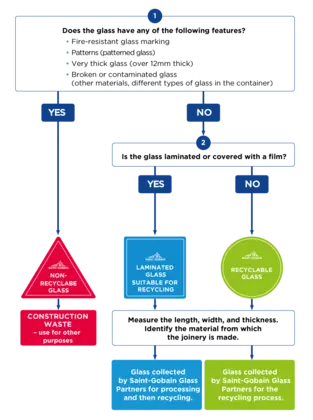
Laminated glass Glass laminated or coated with film suitable for recycling.
Compatible with flat glass recycling in a closed loop.
Laminated glass
Consists of two layers of glass bonded together with a polymer layer – only if made from standard PVB (polyvinyl butyral) or EVA (ethylene-vinyl acetate copolymer).
Film-covered glass
This type of glass is covered with a plastic film (stickers, frames). This type of glass should be treated the same way as laminated glass (recyclable laminated glass).

Laminated glass

Folm-covered glass
Laminated glass requires additional treatment during the recycling process - the film from the laminate must be removed in order to reuse the glass. this fraction is therefore separated out.

Glass incompatible with flat glass recycling in a closed loop.
This category includes:
- Fire-resistant glass with an intermediate layer,
- Laminated glass made from materials other than PVB and EVA,
- Decorative glass, mirrors,
- Borosilicate glass,
- Solar panels,
- Electrochromic and photochromic glass, glass with electrical components,
- Enamelled glass, digital printing,
- Reinforced glass.

Packaging glass

Fire-resistant glass

Contaminated glass

Thick glass, over 12 mm

Patterned glass

Electrochromic and photochromic glass, glass with electrical components
Other types of glass and materials:
- glass-ceramic elements: stoves, etc.,
- glass bottles and other containers,
- tableware (glasses, cups, carafes, jars, etc.),
- crystal (lead glass),
- laboratory glass (test tubes, beakers, etc.),
- light bulbs and lighting fixtures,
- decorative glass elements,
- TV, computer screens,
- construction waste (aggregate, concrete, rubble, sand...),
- items containing asbestos, putty (seals in old windows),
- glass shards contaminated with any other waste,
- other components of an insulated glass unit (spacer frame, sealant, desiccant, corner connectors, inserts).
This type of glass is suitable for disposal or use by other industries.