
Why do glass tables explode?
- nickel sulfide
Several times on the Internet I have encountered articles with shocking titles, such as: "My glass table exploded!". Underneath I found a plethora of comments - from mocking the author, to attempts to explain the phenomenon with, for example, too loud music and the table falling into resonance. Meanwhile, it is very likely that the culprit of the "explosion" of many glass tables is.... a particle smaller than the diameter of a human hair.
Glass spontaneously explodes
People who wrote on online forums about their exploding tables were often muddled in the comments. After all, it's hard to accept that a glass panel can explode by itself. But at the outset of this article, we have to admit that the former owners of glass tables are right - glass can indeed "explode" on its own.
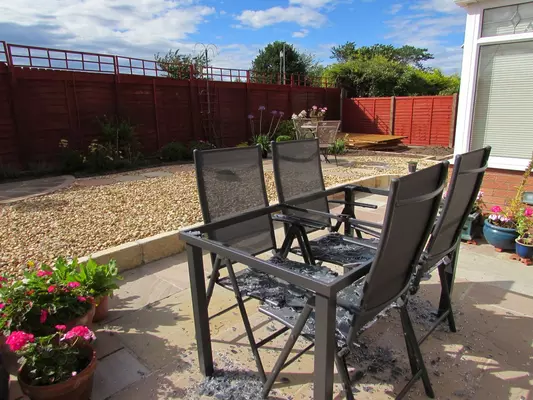
Tempered glass
At the same time, the word "explode" is somewhat exaggerated. To understand what this "explosion" is, one must first understand the essence of tempered glass. For such "explosions" can only happen in tempered glass. Why? Because very high stresses are locked in such glass.
To visualize what these stresses are, imagine a school ruler. If we hold it normally in our hands and start sawing in the middle, the ruler will maintain continuity (i.e., it will still be one piece) until it is completely cut. When we finally complete the cut, nothing spectacular will happen, except for the fact that two rulers have been formed from one ruler.
It will be completely different if you, as it were, "put" tension in the ruler. To do this, imagine that you squeeze the ruler, bending it into a sizable arc. This time you also start sawing the ruler in the middle. Intuitively, we know that we won't finish the cut, because at some point - when the indentation is large enough - that narrow piece that still connects the two parts of the ruler will simply break. At the moment of rupture, the stress will be released in the form of kinetic energy and both pieces will shoot out to the sides. The force needed to eject the two parts of the ruler was all the time "locked" in the arched ruler. Only its breakage released this force, so that both pieces of the ruler "shot out."
The same is true of tempered glass. After the tempering process (it involves heating a sheet of glass and then rapidly cooling it), tensile and compressive stresses (the equivalent of a taut ruler) appear in the glass. These make the glass much stronger.
However, once it breaks, the "trapped" stresses will release and scatter the pieces of the broken glass, creating the sensation of "explosion", just as the pieces of the ruler "shot" to the sides.
Not only that - because the compressive and tensile stresses are in an ideal state of equilibrium holding the sheet in its entirety, all it takes is for this equilibrium to be gently disturbed, and the stresses will cause a crack across the surface of the sheet. This means that even a slight disturbance in the continuity of the sheet is enough for it to shatter into a fine poppy. If we want to make a hole in the tempered glass, break off a corner, or chip an edge - in any of these cases, the tempered glass will break over its entire surface, as in the video below.
The mystery of exploding tables solved?
Thus, the "explosion" of a glass table can be caused, for example, by the depletion of an edge. This disturbs the equilibrium state of stresses in the glass, and these are released, causing the entire sheet to dynamically break into small pieces. Even tugging hard on such a table can destroy it, as in the video below. Notice that the broken glass fragments fly off to the sides, even though no one gave them any force. This force was just given by the stresses released during the fracture, which were previously "locked" in the glass. This effect will be stronger the thicker the sheet.
But what about the accounts of people who claim that the table broke spontaneously when nothing was on it and no one was present around it? Well, they may be right.
Nickel sulfide inclusion
The so-called nickel sulfide inclusion is most likely responsible for such cracking. But how can a particle smaller than the diameter of a human hair destroy a large and thick glass table?
As we discussed in the previous section, the force capable of breaking a sheet and throwing pieces of it some distance (the so-called "explosion") is locked up in the sheet itself in the form of stress. It just needs to be released. And the nickel sulfide molecule is capable of such a release.
Explanation of the phenomenon
Nickel sulfide particles appear in typical silicate-soda-lime glass in very small quantities. It is estimated to be about five particles per more than a ton of glass. However, it has still not been possible to eliminate them completely.
Nickel sulfide is characterized by the fact that it exists in two forms - low-temperature and high-temperature. The former persists below 390°C, while above this temperature, the particle changes to the second form. The key fact is that the former has a larger volume, while the latter has a smaller volume. This means that when the glass is heated, the nickel sulfide particle is smaller than when it is cooled.
During quenching, glass is heated to a very high temperature, which causes the nickel sulfide in it to go into a high-temperature (smaller) state. After a while there is a rapid cooling so the molecule seeks to return to the low-temperature (larger) phase. The problem is that it can't, because it needs a certain amount of time to do so, and the taffy has been cooled too quickly. The molecule wants to increase in volume, but doesn't manage to, and is "frozen" in the high-temperature form, even though its temperature has dropped. So all the time it is striving for transformation - it is just waiting for favorable conditions.
Such glass leaves the manufacturing plant and goes to the customer. It is very possible that favorable conditions will never happen and nickel sulfide will not cause cracking. But it is also possible that nickel sulfide at the stage of use of the glass by the customer, will have the opportunity to go into a low-temperature state. Then it will increase in volume disrupting the state of stress equilibrium in the glass, as a result leading to the cracking of the sheet. And that, as we discussed earlier - tempered glass breaks very dynamically - the so-called "explosion" will occur. Such a situation is captured in the video below.
What conditions favor the release of nickel sulfide?
Generally speaking - heating the glass. The particle then has time to transition into a larger volume low-temperature form. Placing a hot jug acutely in the place where the particle occurs, can lead to the destruction of the table. Also, exposure to sunlight directly on the sheet can result in cracking. In articles I have read, it was often reported that the table "exploded" after its owner put it in the garden on a sunny day. In that case, you can be almost certain that nickel sulfide was responsible for the destruction of the table.
Construction glass
The problem with spontaneously cracking glass is much more serious in construction glass. If a several-meter-high glazing installed on the twenty-seventh floor of an office building breaks, it can be very expensive to replace. That is why construction glass is increasingly subjected to the so-called Heak Soak Test (HST). It involves eliminating sheets that have nickel sulfide inclusions. The hardened sheets are placed in a furnace, which provides ideal conditions for the release of the molecule in question. If a given sheet has a nickel sulfide inclusion, it will simply break during the test. Although this method is not 100 percent effective, it eliminates the most vulnerable panes to cracking with great certainty.
Is it possible to see nickel sulfide?
Some tempered glass is additionally laminated. In short, the process involves bonding two (or more) sheets of glass together with a film between them. This ensures that even when the glass breaks, it is so well bonded to the film that it does not spill into small pieces. Laminated glass, for example, is the windshield in a car. Despite cracking, it always stays whole.
If a crack occurs in tempered-laminated glass due to nickel sulfide inclusions, the glass will crack all over the surface of the sheet, but will not shatter. Then we can observe a very characteristic grid of cracks. This is because the cracks will descend to a clear center, where we will find the so-called butterfly. Two similar-sized hexagons, with one common side. Exactly in the center of this side is a particle of nickel sulfide.
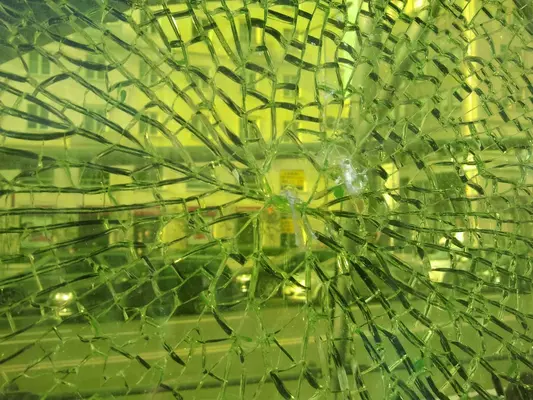
I observed such a phenomenon, for example, in Warsaw on the glazed entrance to Swietokrzyska station. Interestingly, it occurred on two panes of glass next to each other! It could have been influenced by the fact that colored glass has a higher absorption, which makes it heat up more. In addition, the panes faced south and were mounted at an angle, so they were more exposed to sunlight. All this increased the likelihood of conditions conducive to the release of nickel sulfide.


Another place where I have observed the same cracked panel is the fountain in the market square in Wroclaw. It has not been replaced for several years, so I suspect it will stay that way.
I also encountered the same kind of crack a few years ago on a section of the glass floor around St. Adalbert's Church in Krakow's Market Square. Interestingly, even though the sheet was cracked, it still provided load-bearing capacity and could be walked on.
How do you protect yourself?
As I wrote, the inclusion of nickel sulfide is a very rare phenomenon. To become the owner of an "exploding table" one must be really extremely unlucky. So the vision of an "exploding" table should not be a reason for us to give up a piece of furniture that we like. It is also not the case that the tables of a certain manufacturer will break, and another will not.
An HST test performed on our panel could protect us from a cracked table. However, I have not met a furniture manufacturer that uses it. The risk of "bursting" is so low and the consequences so small that incurring the high cost of performing such a test is not justified.
All the more so because the table itself is not dangerous either. After all, another thing that distinguishes ordinary glass from tempered glass is the fact that the latter shatters into small fragments with relatively blunt edges. They are not able to do us as much harm as even large and sharp fragments of cracked annealed glass.
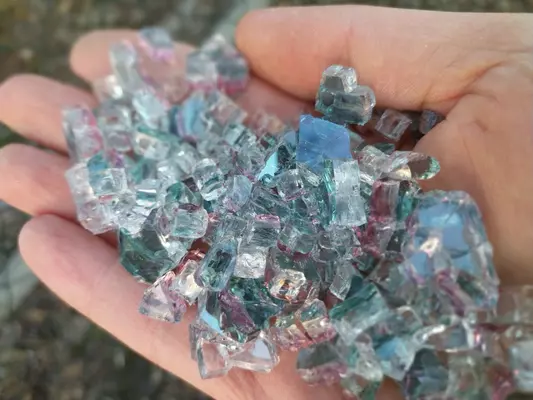
Nevertheless, once you own a glass table, it's worth avoiding exposing it to conditions conducive to the release of the nickel sulfide molecule. So it is worth avoiding heating it, for example, by placing hot objects on it without a stand or exposing it to sunlight. Then we will minimize the likelihood that the mysterious phenomenon of exploding tables will happen to us.
Bibliography
• https://www.swiat-szkla.pl/aktualnoci/186-wydanie-1-2010/3077-inkluzje-siarczku-niklu-w-szkle.html
• https://www.pressglass.com/pl/oferta/szklo-specjalne/heat-soak-test-hst/
• http://en.sado-group.com/NewsDetails.aspx?nid=64