
Transformation of Tryggehuset II

effort for old house renovation – part II
Famous Swedish architect Gert Wingårdh once said that you have to be naive to realize your dream house. I can agree with that. In 2021-2022 we converted a barn in Tryggestad outside Borgholm into a residential building. One of the big driving forces was that I wanted to realize my vision of the house.
The barn with roots in the 19th century was converted into a residential building by mother-in-law Annalena back in 1980. An old house that was partly a ruin had its roof lifted, a magnificent fire place with three stoves over two floors was built in it, and the footprint was expanded to its original 8x16 meters on the outside.
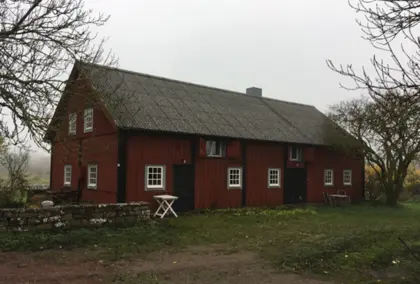
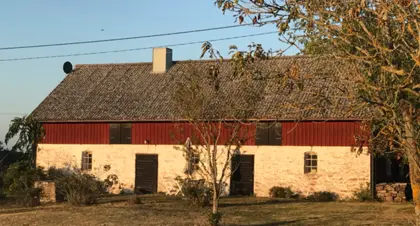
The barn photographed 2018/2019
The problem we saw was that windows at that time were built as small as postage stamps. And that the dark house was divided into too many rooms according to the purpose of the time to provide space for three children, a sauna, etc. The grand and not really expensive plan was to remove the intermediate floor in the extension to reach full height in the northern third of the house. To put large glass sections in that part and have our workplaces at the edge of the mezzanine level, with a view of the alvar. As well as removing a lot of other partition walls. The strange smell in the house seemed to come from the cork plastic carpet, which needed to be replaced.
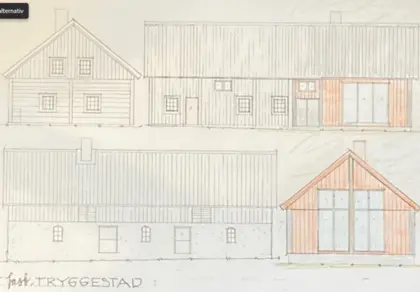
The vision translated into building permit drawings by architect Leo Eriksson. Large windows to the north and east, where the change is not visible on the village skyline.
The road to the goal was oh so long:
- Under the cork plastic was floor chipboard and 5 cm of foam plastic. Then an unreinforced old barn floor in concrete where the unevenness had been smoothed out with joint sand.
- In the east, ants had eaten away parts of the foundation. In the south, the old wooden foundation was completely rotted away. The house was somehow floating.
- Rats had taken over in the partition walls and cavities, there was rat droppings everywhere
- The electrical system and water/sewerage did not meet today's requirements. Neither did the bathrooms
We had to empty out most of the house to renovate and then build a new house under the beautiful eternit roof from 1980.
The floor was broken up and we dug ourselves down 50 cm below the old floor level. 10 cm of macadam, 20 cm of cellular plastic and 10 cm of concrete with water-borne underfloor heating gave 10 cm of additional ceiling height on the ground floor.
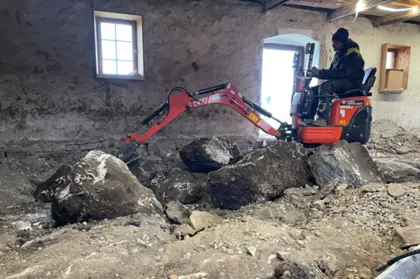
To the south were large blocks of stone that could not be lifted out; they had to be milled down inside the house.
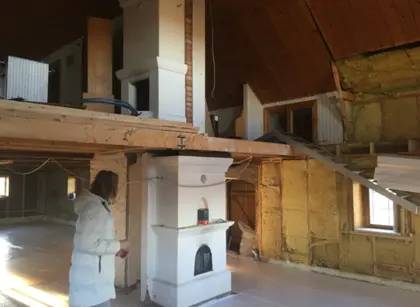
Once the concrete floor was in place, there was still a year of work left. Luckily we didn't know that at the time...
Inside the original limestone wall to the west, a Leca block wall with a 3 cm air gap was built. The air gap was filled with Leca balls, the result was very good and the other interior walls on the lower floor were also built up in Leca blocks which were plastered with Kalkbruk C. The gates to the west held a secret: They were widened towards the inside, which allowed for large amounts of light to enter places where we feared poor daylight.
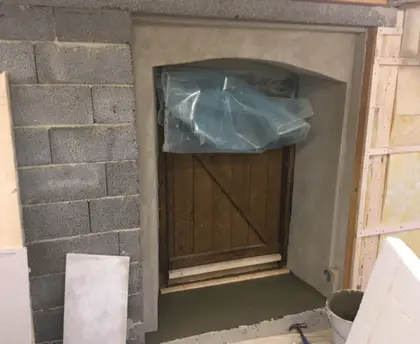
The added wall on the right in the picture is single-brick and was insulated in a conventional way. On the inside of the doors we installed 140 cm wide window sections from Leiab.
In the north, a thick glulam beam was placed in the middle of the gable to support the roof ridge for the window section. In the east, a horizontal beam did the same job.
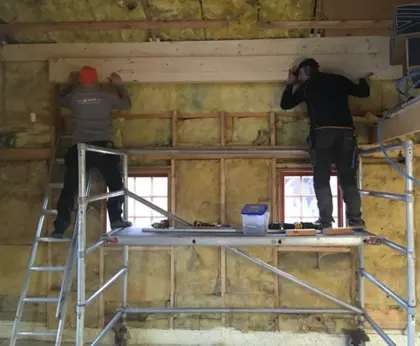
Esa Tukia and Nicke Gotlänning lift the eastern beam into place.
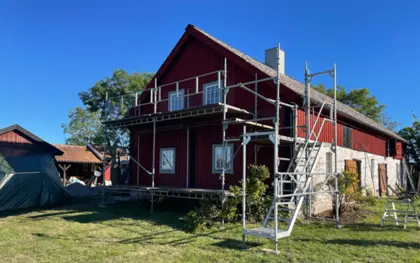
The north facade is ready for a breakthrough. We had to wait a long time for the facade builder OGMAB, who had a lot of extra work on a project in Borgholm.
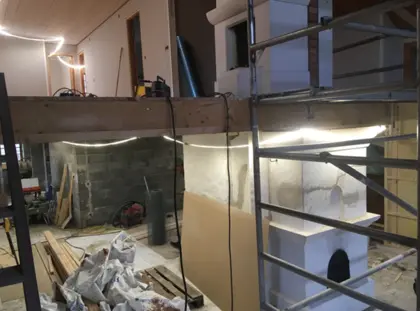
Interior walls completed. No new walls were built upstairs, those that were not removed were covered in new plaster.
Up to this point we had to fumble in the dark with the help of experienced builders. The costs obviously went up, the whole project ended up at least six times over budget.
So what is it about this project that stands out? How have I used my experience to come up with solutions that others can be inspired by? I would like to devote the rest of the article to how we ensured good air quality and good thermal and acoustic comfort.
Acoustics
Concrete floors, plastered walls, sparse furniture, large windows, partly high ceilings. It sounds like a church with a lot of echo, or a party room that you leave hoarse. But at our house there are acoustic panels in the ceiling throughout the downstairs, including the double-height part. Ecophon type F could be screwed directly into the old ceiling panel in the extra-high part. In the low part, it is screwed into battens that were placed between the old beams. The result is very peaceful, something that strikes visitors as soon as they enter.
Ventilation
When we made the decision to take out out large parts of the house, we decided to install mechanical ventilation. There are a lot of ducts in the attic and supply or exhaust air according to the textbook in every room. The house always smells new even though the occasional rat shit is probably still stuck in a wall. My sinuses have also completely stopped fighting with me.
Thermal comfort
We have connected the geothermal heating system with the ventilation. Cold liquid is led up from the borehole to a cooling coil placed at the supply air duct, which provides “free cooling” where the supply air is cooled to 14 degrees. In winter, an aluminium door from Purso, wodda/alu windows from Leiab and timber bARK sections from Fasadglas do not cause any problems with cold drafts thanks to modern triple glazing and highly insulated profiles. In summer, the triple glazing’s outer glazing provides coolness to the east and west: COOL-LITE® XTREME 70/33 lets in maximum daylight but completely blocks the infrared heat from the sun.
All that sounds like a rosy story. But far from it. Midsummer 2023 when everything was connected, we reached 28 degrees indoors and I went through an existential crisis. This project was very much about self-realization, creating a bright environment that was still not too hot, even with upcoming climate change. Had the gold turned to sand?
When you break down, you can bounce back again. Now the indoor climate works – if we watch it like a hawk. Because free cooling has very low effect and we have not yet found a way to also use geothermal energy for active cooling. If anyone has cracked that nut and can help cool our floor, they are welcome to get in touch…
Listing the measures we have taken to make it cooler indoors can be seen as the core of the article:
- Make the system work: Electricity, ventilation and HVAC pointed to each other when the air was not cooled as it should, three contractors have their intersection up there. It turned out that a water trap was missing on the cooling battery. But by that time in July 2023, the house was already overheated. With a cooling capacity of around 1 kW, it was just a matter of waiting until autumn.
- Put up sun protection curtains everywhere: We had motorized interior solar shading on the large partition to the east. Together with the solar control glass, it allows minimal heat in through those glasses. But even small windows can transmit a lot of heat, and heat up black countertops, for example. Solar control curtains everywhere inside were an early measure. Except in the north. Raising and lowering along the sunpath is part of the daily summer rituals.
- Paint the doos white: In the west, we can close the old barn's black gates in front of the windows and protect against the sun. With well-insulated windows inside, however, it became insanely hot in the space between gate and window. White doors lowered the temperature there by 10-20 degrees, building physics turned into reality.
- Ventilation in the attic: Where the unit is located, it was quite poorly ventilated, the only opening was along the ridge. It was often 40 degrees up there, which heated the air ducts. Extra vents in the gables to the north and south create a cross draft that lowers the temperature average by quite a few degrees, especially cooling it off faster in the evening, which helps with summer night cooling (cooling by taking in cold night air via the ventilation).
- Trim the ventilation: In the summer, we can increase the ventilation from 60 to 80% of maximum capacity. The cooling coil can handle the entire air flow. And I was careless with changing the filters at first. Now I change them twice a year so that the filters don't have time to clog and reduce the air flow.
- Morning ventilation: We have some flies buzzing in the surrounding horse paddocks. We don't want them in. The system was designed to be closed. But in the morning you can set a cross draft with good and fly-free results; under the right conditions we experience wind speeds of several meters per second indoors.
- Solar control curtain in the north: In the end we realized that perhaps the worst heat culprit was our 16 square meter glass section in the north. No solar control glass, large surface area, morning sun, evening sun and what is called background radiation make the heat from there very troublesome. In the summer of 2024 we installed eight manual white roller blinds from Jysk. I stood on a stool and pulled the control chains with the help of a garbage picker from the local discount store. It wasn't pretty and you didn't look good. But it proved the theory that the heat was coming from there. Two five-meter-high motorized ClearView solar control curtains from Kvadrat Shade provide a significant improvement. I can gently press the remote control and see them whisper down with their Somfy Sonesse motors. And even though only three percent of the fabric is open, the metallic exterior and black interior combine to create a stunning view. And that's lucky because they're down all day when the sun is shining. And they face the most beautiful view.
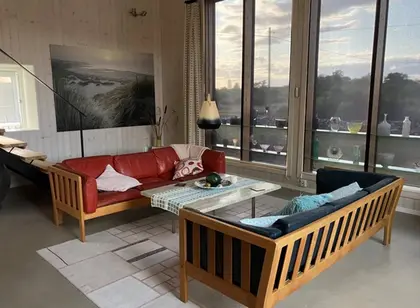
View through sunshade to the north, openness factor 3%
When we aimed for thermal comfort with good daylight in the house, I thought it would be ideal to turn the largest part towards the north. Then I could choose the low e glass ECLAZ®. It gives the subjectively most fantastic view. I had to urgently buy a replacement glass due to a heat crack (it was very hot the day the glass was distributed). And that pane is with “regular low e glass” which is more yellow in the transmission. When I look through it, I know why ECLAZ® is the right choice. But if there is one thing I regret, it is that I did not choose the lightest solar control glass SKN 183 towards the north. Then I probably wouldn’t have had to mess with curtains there.
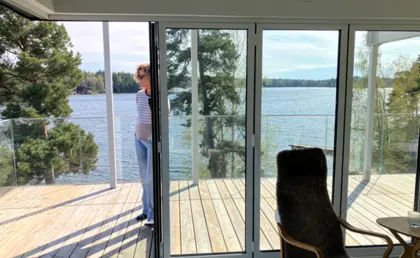
COOL-LITE® SKN 183 is not that bad. Here in a folding partition from Villa Ola, Askersund.
Then I also regret that I didn't do more research on free cooling, the effect is much lower than I thought. Maybe I could have fixed floor cooling in the design phase. If the concrete floor had stayed 18 degrees all summer, it would have been effective cooling. Or I could have prepared for more cooling up in the attic before the ducts were closed. It was still a very successful project. The above two regrets are actually the only two things we regret of the 148,713 decisions that were needed from start to finish. And at the time of writing on July 1, 2025, it is 21.6 degrees at the workplace and 20.5 degrees in the bedroom.