
Interior shading analysis

Regionens Hus Gothenburg was a breakthrough project, changing a hybrid façade to solar control glass + inside shading reduced façade cost by 30%.
A guideline to optimizing glass and inside shading
When you apply a thin coat of aluminum to a textile it stops being translucent. Translucent light can be a glare in itself, and when that is eliminated the glare is stopped effectively. And the open parts are sharply defined. And with a dark color inside and a correct design of the holes in the fabric it can provide good views to outside even with a very low openness factor of 2-4%. If it has been designed well. The coating and application methods have been vastly improved in recent years, bringing reflectance up as high as nearly 85%. This in turn means that the shader can act as an extra sheet of low e glass in the IGU, lowering the total u-value. And perhaps more important that it can reflect the visible radiation of the sun very effectively compared to other internal glare control devices.
The favorite material to apply metal to is PVC, because it has a very smooth surface. But to improve sustainability great progress has been made also in the area of coating the rougher polyester fibre, excellent products of both types exist on the market.
When correctly combined the effect of a solar control glass can be doubled by the inside shading. But that requires sensitive balancing of products and a fully spectral calculation of the resulting g-tot.
In Sweden glass + inside shading has been the dominating way of designing facades for at least the last five years or more. Investors feel safe with the solution and consultants know how to simulate. The design correctly applied performs well where 85% reduction in solar energy is required, g-tot 0,15.
But often you want to reach lower to comply with building certification demands in certain critical rooms. Then ESBO gives plenty of opportunities to explore and twerk the solution into a lower reported value. It is time to publish a guide to what actions can be taken and what outcome to expect.
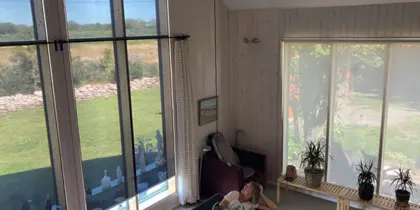
Kvadrat ClearView 0190 black to the left, ClearView beige to the right. When all shadings are down in a room it can get quite dark inside.
I have chosen a baseline combining an alu-coated polyester fabric from Kvadrat Shade and the COOL-LITE® XTREME 70/33 glass from Saint-Gobain. The glass has takes away the infrared part of the solar energy and the rest of the energy is reflected well by the shading. Solar energy does not change when hitting a material, it is reflected or absorbed. The wave lengths that have entered through the glass can thus return out again if they are reflected. What goes through in one direction can pass through in the other direction. This sounds simple enough but it is the reason why the fully spectral calculation works so much better than an calculation with average values.
Here I will study the effects of:
- different glass coatings,
- thicker glass,
- different substrates,
- different fabrics,
- ACT façade,
- narrow windows.
The baseline
The outer part of this solution is the glass. It is very important to optimize this because it is the first spectrophotometric filter for the solar energy. This is the key to the full spectral analysis. And it is tricky because it moves beyond the LT and g-values normally specified for a glass. The all important g-tot value is calculated in line with EN 52022-3 under reference conditions. There is also a summer condition that some would argue is more suitable. But all softwares calculating fully spectral in line with 52022-3 do not calculate summer conditions. 6 mm thickness is used for the outer pane and 4 mm for the inner panes.
I have chosen the COOL-LITE® XTREME 70/33 glass for reasons explained earlier: high selectivity, low reflection and I can now add easily accessible. It is no longer an exotic glass but well spread with countless references. In Sweden the biggest glass processor keeps it on stock.
For the interior roller shading I have chosen Kvadrat Shade Niesen 0190. From non-PVC shadings this has the highest reflectance, providing good g-tot values and relief of high operative temperatures. In essence you will not really feel directed heat from the window. The black inside, the aluminized outside and the structure of the openness all contribute to a good and glare-free view of the outside even though the openness factor is as low as 3%. In addition the Kvadrat shadings are generally mounted on the Somfy Sonesse motor, a very silent option.
| glass | shader | LT | g | g-tot | u-value | "u-tot" |
| DGU XTR 70/33 | Niesen | 70% | 0,33 | 0,12 | 0,98 | 0,78 |
| TGU XTR 70/33 +XN #5 | Niesen | 63% | 0,31 | 0,14 | 0,56 | 0,48 |
As expected, it is easier to push the heat out through a double glass unit (DGU) than a triple glass unit (TGU). With 70% LT and g-tot of 0,12 the selectivity of the system is close to 6.
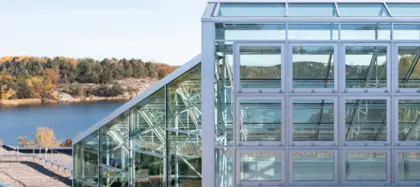
COOL-LITE® XTREME 70/33 at Gate:01 Frösundavik
The TGU solution adds a standard low e glass PLANITHERM® XN on the inner pane #5. It loses two percentage points on the g-tot value and the selectivity of the system drops to 4,5. But the 17 percentage points reduction it does achieve has caused a paradigm shift in Swedish facades, making solar control glass plus inside shading the first choice in façade design.
An interesting side effect is that the u-value is affected by the shader. It is almost like adding an extra glass in the IGU build-up. Shadings can be activated to improve insulation at night. The ESBO report shows the u-value for glass plus shader and the effect on energy consumption can be quantified in an IDA-ICE calculation. But such an advantage is normally not possible to use for compliance with local building regulations.
Interior roller shadings is more often cursed for limiting solar heat gain in the winter. In the winter the low sun will force glare control down and the solar control properties strongly limit potential heat gains. IDA-ICE simulations show that the positive u-value effect of the shading compensates in full for the negative effect on winter solar heat gain.
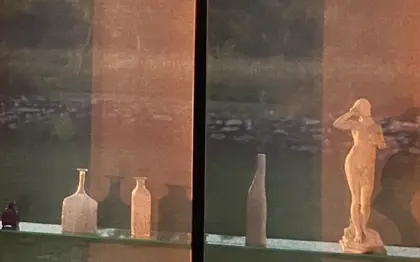
When the sun hits the shading at an angle, it hampers view to outside a bit. The roller shading is in front of the decorations.
Solar control glass plus inside shading has a low initial carbon footprint. You need a window and you need glare control in any case. Nothing but ultra-thin coatings are added. A standard LCA analysis does not provide the same certainty when choosing glass+shading solution. It has to do with standard assumptions for life span. Facades is set to have double the life span of IGUs, outside shadings to have double the life span compared to inside shadings. I would question both assumptions. And point out that cleaning the windows is the only maintenance required for glass + inside shading.
The glass substrate used in these calculations is Saint-Gobain standard floatglass Planiclear. It can be shifted to low carbon glass ORAÈ® without any change in the spectrophotometric values. The embodied CO2 of the glass can be calculated and compared in the Calumen software.
Different glass coatings
I will start with an example showing how a similar glass can bring very different value. The COOL-LITE® SKN 154 glass has good selectivity, and the reflection is not enormous. But the change has critical effects:
| glass | shading | LT | g | g-tot |
| DGU XTR 70/33 | Kvadrat ClearView 0190 | 70% | 0,33 | 0,12 |
| DGU SKN 154 | Kvadrat ClearView 0190 | 52% | 0,28 | 0,12 |
| TGU XTR 70/33 + XN#5 | Kvadrat ClearView 0190 | 63% | 0,31 | 0,14 |
| TGU SKN 154 + XN#5 | Kvadrat ClearView 0190 | 47% | 0,26 | 0,13 |
Replacing COOL-LITE® XTREME 70/33 with COOL-LITE® SKN 154 You loose up to 18 percentage points in light transmission with virtually no gains in g-tot.
If you want to shift coatings to improve g-tot the discussion mainly applies to triple glass units: The low e glass PLANITHERM® XN can be replaced by the innovative low e coating ECLAZ®. ECLAZ® has a spectral curve that allows a freer flow of different wavelengths to pass to the outside. And if this coating is moved to #4 middle pane there is improvement:
| glass | shading | LT | g | g-tot |
| TGU XTR 70/33 + XN #5 | Kvadrat ClearView 0190 | 63% | 0,31 | 0,14 |
| TGU XTR 70/33 + ECLAZ #4 | Kvadrat ClearView 0190 | 65% | 0,30 | 0,13 |
One percentage point is gained at nearly zero cost. And light transmission is increased.
If you want to shift solar control coating I have two suggestions: Use the COOL-LITE® SKN 183 for improved light transmission and the COOL-LITE® XTREME 61/29 for improved g-value. I will make the examples in TGU only from now on.
| glass | shading | LT | g | g-tot |
| TGU SKN 183 + ECLAZ #5 | Kvadrat ClearView 0190 | 69% | 0,37 | 0,16 |
| TGU XTR 70/33 + XN #4 | Kvadrat ClearView 0190 | 63% | 0,31 | 0,14 |
| TGU XTR 61/29 + XN #4 | Kvadrat ClearView 0190 | 55% | 0,27 | 0,13 |
COOL-LITE® SKN 183 is set with ECLAZ® in the table because of the aim to maximize daylight. The other 2 back down to the PLANITHERM® XN #5 baseline. COOL-LITE® SKN 183 provides a weaker first line of protection with a 0,37 g-value. But the light transmission is very close to standard low e glass and equal to as a traditional Swedish 2+1 window. It is a perfect solution if you need solar control glass when a daylight analysis is already made. In Sweden these are generally made assuming glass LT 68%. No revision needed.
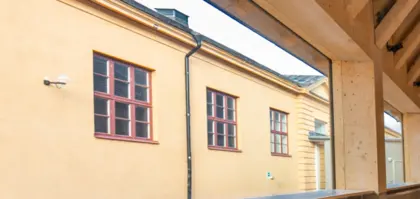
COOL-LITE® SKN 183 at Wisdome Stockholm
COOL-LITE® XTREME 61/29 further strengthens the first line of protection with g-value 0,26. But adds very little to the g-tot calculation. With a loss in LT of eight percentage points. Remember that the difference in g-value between COOL-LITE® XTREME 70/33 and 61/29 comes solely from the removal of energy in the form of visible light.
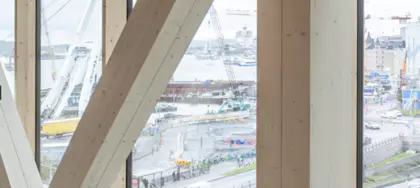
COOL-LITE® XTREME 61/29 at Habitat 7
Thicker glass
Float glass contains iron that absorbs energy. It is the cause for glass to be green. In automotive applications iron content is usually raised from the 500 ppm of Planiclear to 9000 ppm to prevent overheating and to provide some glare control. With thicker glass more iron is present and that influences g-tot. I managed to make a combination of 8-6-66.2 in ESBO. Increasing the total glass thickness from the 14 mm of 6+4+4 to 22 mm and adding some PVB-interlayers increases g-tot by 1,5 percentage points:
| glass | Build-up | shading | LT | g | g-tot |
| TGU XTR 70/33 + XN #5 | 6+4+4 | Kvadrat ClearView 0190 | 63% | 0,31 | 0,141 |
| TGU XTR 70/33 + XN #4 | 8+6+66.2 | Kvadrat ClearView 0190 | 61% | 0,30 | 0,156 |
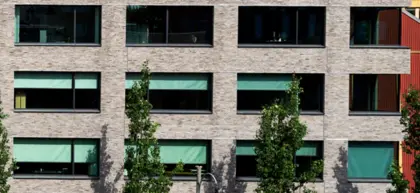
At Merkurhuset in Gothenburg glass buildup is 10+8+66.2. The natural iron content of the glass makes the shadings appear a bit greenish.
Low iron glass
To prevent the effect of iron in thicker glass one can use low iron glass instead. I would not recommend it. It is more expensive, and you cannot increase the use of recycled glass as raw material in low iron glass like you can in standard float glass. I would use the extra money for ORAÈ® low carbon glass instead, more affordable and more contemporary.
| glass | shading | LT | g | g-tot |
| TGU XTR 70/33 + XN #5 | Kvadrat ClearView 0190 | 63% | 0,31 | 0,14 |
| TGU XTR 70/33 + XN #5 low iron | Kvadrat ClearView 0190 | 65% | 0,32 | 0,14 |
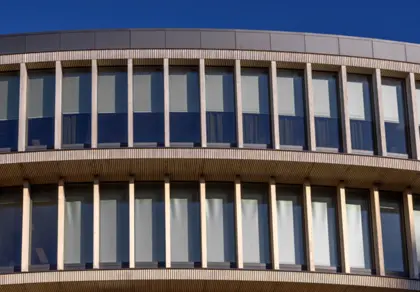
At Kv Forskaren in Stockholm low iron glass counters the greenishness. Why all the different colors? On the level below the top is COOL-LITE® XTREME 70/33+ECLAZ® on low iron glass in front of the shading. The Accoya timer is protected from weathering. The top floor holds COOL-LITE® XTREME 61/29 + ECLAZ® on low iron glass in front of the shading and the timber is fully exposed to rain.
Higher reflectance in shading
Verosol is a sister company of Kvadrat. The Verosol Silver Screen 202RS EB01 (black) has increased reflectance up to nearly 85% with 2% openness factor. You find it in the ESBO database if you sort by outer reflectance or Rs_F as the column is called. It is a very similar product to ClearView but with the metal coated onto the very smooth surface of PVC the effect is higher. And this has a real impact on the g-tot values for compliance. You gain three to four percentage points when switching to a higher reflectance.
| glass | shading | LT | g | g-tot | u-value | "u-tot" |
| TGU XTR 70/33 + XN #5 | Kvadrat | 63% | 0,31 | 0,14 | 0,56 | 0,48 |
| TGU XTR 70/33 + XN #5 | Verosol | 65% | 0,30 | 0,11 | 0,56 | 0,45 |
| TGU XTR 70/33 + ECLAZ #4 | Verosol | 65% | 0,30 | 0,095 | 0,56 | 0,45 |
This brings us down to very low g-tot numbers. Changing the fabric is the easy way out. For compliance purposes it is excellent. Light transmission up to 65% with a g-tot below 0,10 is magical. But for performance purposes the values could be put in question. Non-perpendicular sun, smaller windows, screen far away from glass are some of the issues that will have a negative effect on performance, so the shading is not as stable in performance as the glass. For performance purposes I would not recommend going below g-tot 0,15.
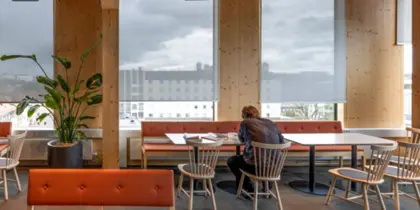
Verosol Silver Screen light grey inside in front of COOL-LITE® XTREME 70/33+ECLAZ® at Magasin X Uppsala
ACT – Actively ventilated façade
You can connect the space between the glass and the shader to the ventilation system, basically sucking out the heat at the top of every window. This is called ACT and will also give a three percentage point reduction in g-tot. And with a better gut feeling for newcomers in calculation. But this is a costly solution, meaning you loose a lot of the charm with inside shadings. It is a niche and uncommon façade type. In fact ESBO cannot calculate it so I had to get a friend to calculate it in a software called SommerGlobal.
| glass | shading | LT | g | g-tot |
| TGU XTR 70/33 + ECLAZ #4 | Kvadrat | 65% | 0,30 | 0,13 |
| TGU XTR 70/33 + ECLAZ #4 ACT | Kvadrat | 65% | 0,30 | 0,10 |
| TGU XTR 70/33 + ECLAZ #4 | Verosol | 65% | 0,30 | 0,09 |
| TGU XTR 70/33 + ECLAZ #4 ACT | Verosol | 65% | 0,30 | 0,06 |
Edge effects, the drawback of interior shadings
All the calculations above are made in accordance with the norms EN 673 for glass and EN 52022-3 for glass + shading. The norm requires the sun to be perpendicular to the façade. This is the hardest case for glass; with the sun at an angle the shiny surface of the glass starts reflecting away energy. But it is the best case for the shading; what is reflected on the fabric bounces right out through the glass. And there is no difference in g-tot for different window sizes and distances of fabric to glass precisely because of how the norm is written.
I asked Bengt Hellström of Equa Simulations to try and make a case study for angular sun: If we assume a spring time case with a fairly low sun we can calculate how much of the shading surface actually helps the window. This varies depending on the solar angles, but here is one example:
- The sun is placed at 30 degrees above the horizon and the sun hitting the window from a 45 degrees azimuth angle.
- Some of the rays will be reflected away directly at the surface of the glass, but we do not consider that effect.
- The reflection in the shading is assumed to be specular.
- The window frame is light grey and absorbs or misdirects 75% of the rays that are reflected from the shading and does not hit the glass directly and reflects 25% of these to the glass
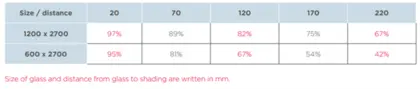
With a narrow window and a deeply set shading we should maybe consider it as if only 42% of the glass is helped by the shading. But then we do not consider the shading’s effect on operative temperature: Even if the heat slowly sifts into the building the shading provides shadow. No surfaces in the office, be it skin or furniture, is locally overheated by the sun.