
Insulated glass is like a packet of chips
- climate loads
When checking the strength of insulated glass, it is necessary to take into account a number of loads that will affect the glazing. It goes without saying that wind force, the glazing's own weight, possible snow loads, or imposed loads must be taken into account. But there is another load that is not so obvious, and which poses an increasing threat. We are talking about the climatic load.
Climatic loads of insulating glass units
At the same time, the very nomenclature of these loads is quite confusing. According to Eurocode 1, climatic loads refer to wind and snow. However, in standards for the calculation of insulating glass units - DIN 18008, or EN16612 - the term "climatic loads" refers only to the loads referred to in this article. Namely, it refers to loads resulting from overpressure or underpressure inside the chambers of insulating glass.
So in the rest of the article I will refer to them as climatic loads. I will also use the term "climatic stresses," i.e. stresses caused by climatic loads, and "climatic fracture," i.e. fracture caused by these stresses.
ρV/T = constans
Insulated glass consists of two or three (very rarely more) panes of glass. Between them are chambers filled with gas - usually argon. These chambers are sealed and the amount of gas inside cannot change. Meanwhile, according to Clapeyron's equation:
ρV/T = constans
ρ - pressure
V - volume
T - temperature
This means that since the amount of gas does not change, with changes in temperature or pressure, it will increase in volume.
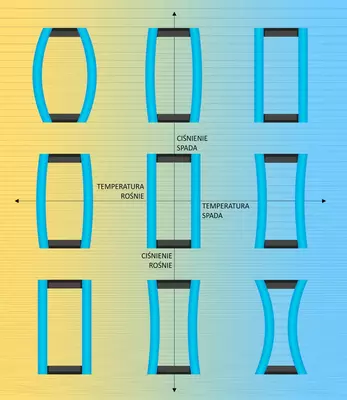
And this in fact happens - the gas contained in the chamber, due to changes in atmospheric pressure and temperature, increases or decreases its volume deforming the glass. Sometimes it interacts so strongly that the glass cracks..
Insulated glass is like a packet of chips
The behavior of insulated glass can be imagined by anyone who has seen a closed packet of chips on an airplane. During high-altitude air travel, the passenger cabin is at a much lower pressure than on the ground. Meanwhile, the package of chips taken from the ground, was packed at normal atmospheric pressure.
So on board the plane it inflates, and in extreme cases it breaks. This is because the pressure outside the packet has changed. According to Clapeyron's equation, the volume of gas inside the packet of chips has therefore increased.
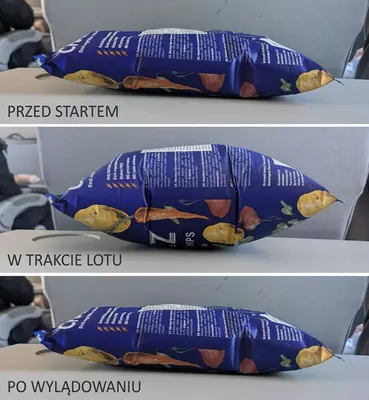
The same behavior is observed in double glazing. The interior of the chamber is sealed, the amount of gas inside is constant, so due to changes in pressure and temperature, the gas will increase or decrease its volume, affecting the glazing.
What affects the magnitude of climate loads?
1.Pressure changes associated with the difference in altitude of the site where the insulating glass unit is manufactured and installed.
2.Fluctuations in atmospheric pressure.
3.Temperature fluctuations.
Climate stresses in practice
I will now describe two extreme situations involving the overlap of several factors.
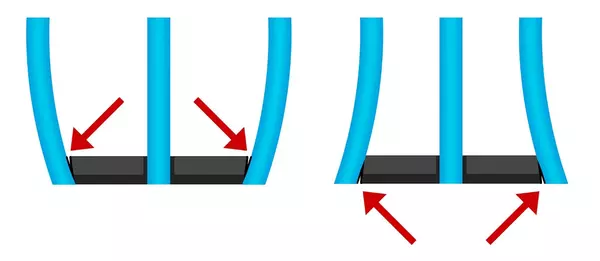
1. suction of the sheet into the center of the composite
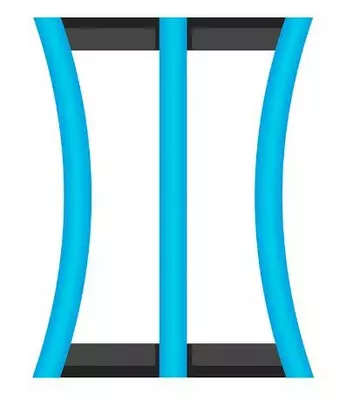
Difference in altitude.
Let's assume that windshields are manufactured somewhere in southern Poland, in a plant located high above sea level. They are then transported to lower-lying areas. There the atmospheric pressure is higher, while inside the insulating unit the pressure remains constant. The glass is therefore sucked into the interior of the unit. The stresses in the glass increase.
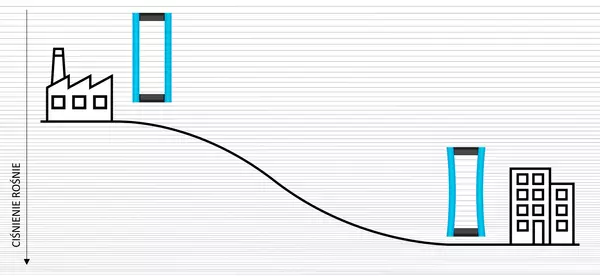
Pressure fluctuations
The glazing is already installed and the high comes, so the atmospheric pressure increases. Inside the unit, the pressure doesn't change, so the air outside the unit pushes our glazing even further into the chamber. The stresses in the glass increase even more.
Temperature fluctuations
In addition, come winter, temperatures drop and the gas inside the unit cools down. As a result, it reduces its volume, creating additional negative pressure inside the composite, further sucking the glass inside. The stresses in the glass increase again.
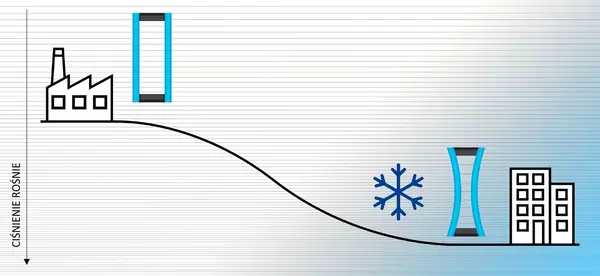
In a normally functioning building, the glazing and is partially heated from inside the building, so the gas does not have the opportunity to cool to very low temperatures. But when the building is just being constructed and is not yet heated, or when the assemblies are stored on site before installation, the gas inside the assembly can even reach sub-zero temperatures in winter. Thus cooled, it will significantly reduce
its volume and suck in the sheets, increasing stresses.
2. Bulging of the sheet outside the composite
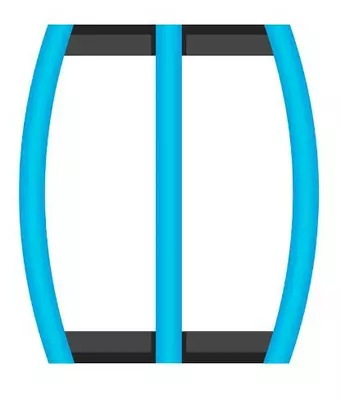
Difference in altitude.
The reverse is true - glazing manufactured at a low-altitude plant goes to higher regions for assembly. The pressure in the higher areas is lower, while the pressure in the assembly remains constant. In view of this, the panes are pushed outward. The glass deforms and the stresses increase.
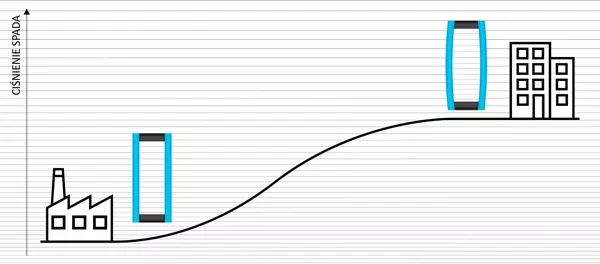
Pressure fluctuations
A low comes, the atmospheric pressure drops even more. The effect gets worse. The stresses increase even more.
Temperature fluctuations
In the summer, hot weather comes and further heats the glass. Due to thermal expansion, the gas increases its volume and bulges the panes even more. The stresses in the glass increase again.
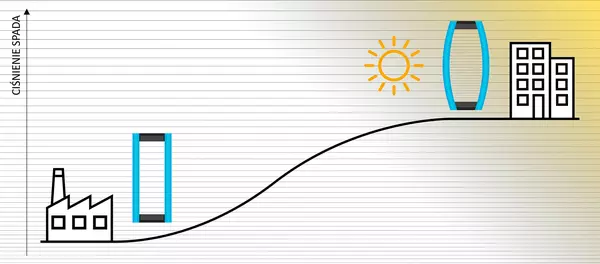
The situation will be even worse when, for example, dark glass with high absorption is used. Then the glass will heat up more, and with it the gas contained in the chambers. The same will work with the installation of solar control devices, such as blinds or shutters, or other elements that increase the temperature of the composite.
I have also heard of climate cracking of insulating glass units when they are transported over mountain passes. At high altitudes, the atmospheric pressure is much lower than where the units are manufactured. In addition, when such transport takes place in the summer, the glazing heats up in the non-air-conditioned trailer. All this means that the windshields can arrive at the assembly site cracked.
What can happen?
Well, just what specific effect can these deformations of the sheetrock have?
1. Unsightly appearance
Any insulating glass unit is more or less prone to bulging and suction. But the more this effect is exacerbated, the worse the facade will look. In particular, if the glass is highly reflective, and the image reflected in it will become heavily distorted.

There can also be a lens effect. I have heard of a situation in which a sucked-in pane of glass so focused the sun's rays that it caused a fire on a neighbor's lot. However, I am unable to confirm the veracity of this story.
2. Package unsealing.
Due to deflections, stresses are created on the insulating glass sealant. The movement of the panes stretches and compresses the sealant, thus weakening the joint and possibly causing the package to unseal. If this happens, moisture can enter the insulating glass unit. In addition, in the case of unsealing, argon escapes from inside the chamber, negatively affecting the insulating properties of the glazing.
3. Cracking
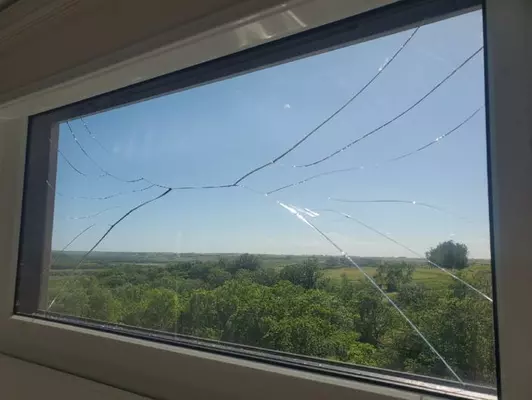
In extreme cases, the stresses can be so high that the glass will crack. What will such a crack look like? About this in the next section.
Cracking of glass due to climatic stresses
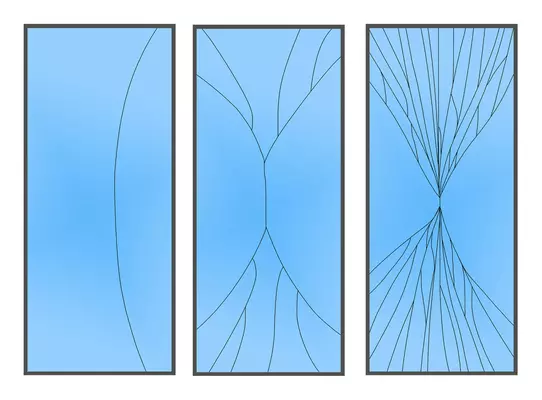
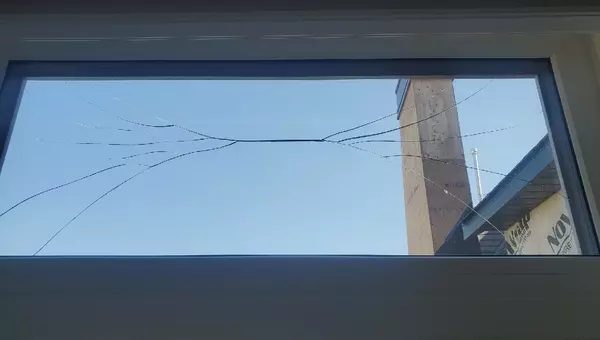
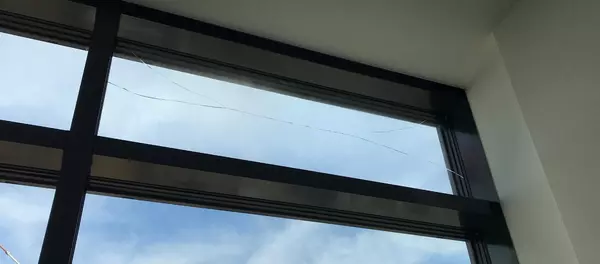
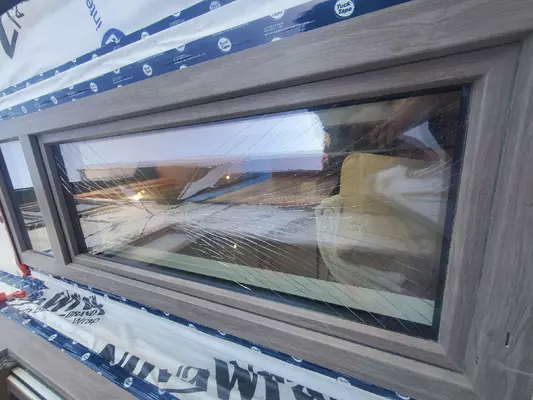
The grid of cracks in glass that has cracked due to climatic stresses is very characteristic. The cracks start near the corners and connect in the center of the sheet. Sometimes, too, it can be a single arc, connecting two corners along the longer edge.
What glazing is most susceptible to climate cracking?
Some glazing is particularly vulnerable to the risk of climate cracking. I have described the most important factors below.
Glazing size
Intuition may tell us that the largest glazings will be the most prone to breakage. Wrong: large panes of glass will deform more easily, so the stresses will be lower. We will get more stress in small, especially narrow panes. So the size is important, as well as the ratio of side lengths.
For this reason, when performing a static analysis of glazing in a facility, it is necessary to consider not only the largest formers, which are most vulnerable to other impacts, such as wind, but also small, narrow formers, where there is the greatest risk of climate cracking.
Glass thickness
Intuition may tell us that the thicker the glass we use, the stronger it will be. Wrong: thin sheets will deform more easily, which will reduce the stresses. Thick sheets, deformed to the same degree, will have much higher stresses, so the risk of breakage will be higher.
When doing a static analysis, it often happens that the glazing is too thin to resist, for example, high wind forces. So we increase the thickness of the package and recalculate from scratch. Then it turns out that there is no longer a problem with wind, but there is a problem with climatic stresses. This makes the intuitive approach on the basis of "the thicker the glass the stronger" completely wrong here, and an individual static analysis for each object is a must.
Width of spacers
The width of the spacer, that is, the width of the chamber, also has a big impact on climate stress. Wider chambers contain more gas, so its volume differences will also be larger.
It's going to get worse and worse
For years, single-chamber glazing dominated in Poland, where the problem of excessive climatic stresses was rare. For several years, however, regulations have enforced the use of double-chambered glass. Such glazing is a much better insulator, but it is also more vulnerable to climatic stresses.
Why?In the case of a single-chamber unit, both panes of glass will deform with changes in pressure or temperature.
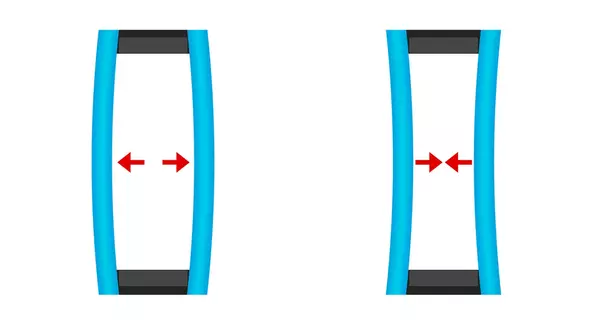
In the case of a dual chamber, under the same conditions, only one pane of glass in a given chamber will deform. The middle pane is common to both chambers, so it will not deform because it will be balanced by pressure from both sides. In effect, it is the outermost panes that will have to "make room" for the increased volume of gas - each in its own chamber.
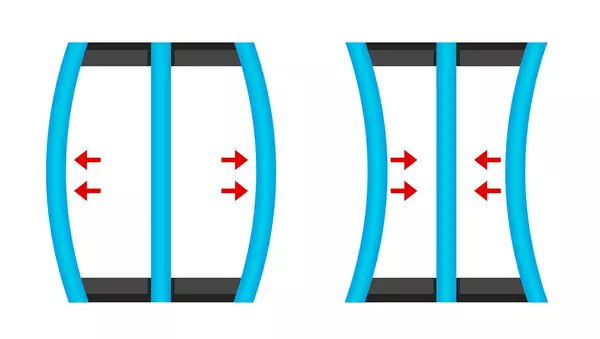
Going back to the comparison with a packet of potato chips - if, on an airplane, you take two "inflated" packets of potato chips and press them against each other so hard that the contacting walls are flat, then
the extreme walls of the packets swell even more.
How to defend against climate stresses?
1. Individual analysis
A static analysis that takes into account where the glazing unit is manufactured, where it is installed and possibly other factors is essential to estimate the possibility of climatic cracking. Insulating glass standards and advanced software give us a high degree of confidence in whether a particular glazing is prone to cracking.
2. Hardening of the outer panes
If calculations have shown an increased risk of cracking, or if you want to be sure that the glass will not break without doing the appropriate calculations, you can temper the outer and inner panes (both extremes). Tempered glass has a much higher strength, so it effectively eliminates the problem of climatic cracking.
3. Use of membranes
An alternative solution is to permanently unseal the glazing package by using a membrane, such as Swisspacer Air. This is a capillary placed in a metal casing and baffled by a moisture-proof layer. It equalizes the pressure inside the chamber with atmospheric pressure. Inside the chamber, air is used instead of argon, which reduces the thermal insulation properties of the glass, but this effect can be partially offset by using
a wider spacer.
Summary
I hope that with the above description I managed to explain the basics about these unintuitive loads. Knowledge of this subject will come in handy more and more often, because I am sure that with the increase
in the share of double glazing in Polish buildings, the amount of climate cracking will increase.
Bibliography
• Norma DIN 18008-2,
• https://encyklopedia.pwn.pl/haslo/gazowe-prawa;3904479.html
• "Sprzężone gazowo płyty szklane w budownictwie. Sposoby badań i obliczeń.", Zbigniew Respondek
• "Insulated glass units with pressure compensation", Bernhard Weller, Mirko Köhler
• "Climate loads in insulating glass units: comparison of theory and experimental results", Stephan Buddenberg, Peter Hof, Matthias Oechsner