
The appearance of modern glass

I focus my prescription on four types of glass; ECLAZ® LUMI, COOL-LITE® SKN 183, COOL-LITE® XTREME 70/33 and COOL-LITE® XTREME 61/29. They all have an external reflectance below 15% in triple glazing, just below that of traditional 1+1 connected windows. Low reflectance gives a very good view to outside but also makes window openings look dark and facades can look a bit gloomy.
The reason for the darkness is that low reflectance gives a good view through the glass. And the daylight factor indoors is usually between one and two percent, which makes the inside appear dark. If you have fifty times more light on the outside than on the inside, that's what happens. Architects' renderings often look brighter than reality. Either you choose a much higher daylight factor or you render twilight images when the effect of daylight has diminished. Twilight is also popular when it comes to taking reference photos. Preferably with all the lights on indoors.
Why not brighten up the facade with more reflective glass? I would like to give three reasons to avoid it:
- High reflection goes both ways. At dusk, the view deteriorates quickly, and in the dark, the reflection hampers any view to outside, the window becomes a mirror.
- Reflecting away daylight means lower light transmission; what is reflected away is by definition lost to the inside. It feels a bit wasteful.
- Modern triple-glazed facades have higher climate loads than the double-glazed facades built at the beginning of the millennium. A hermetically sealed insulating glass unit bends outwards when it heats up and inwards when it cools down. It forever carries with it the weather from the day of production, which means different curvatures for different production days. A highly reflective glass attracts much more attention to that effect than a low-reflective one. If you pass by a triple-glazed facade with more reflective glass, bits and pieces of reflected images fly back and forth.
The trend towards low-reflective glass means that windows look darker now than they did last millennium. When uncoated glass dominated, you could count on 4% reflection in each glass surface, 8% perpendicular reflection in the outer glass. In a modern solar control glass, the reflection in the coated inside of the outer pane goes down to 0, a halving of the reflection of the outer glass. It is the outer glass that determines most of the appearance of the facade, which makes the impression darker, the difference is greatest at an angle. The pictures below show uncoated outer glass in the large north-facing section on the right and solar control glass in the east-facing section on the left. The uncoated outer glass gives a shine at an angle that is partly lost in the solar control glass.
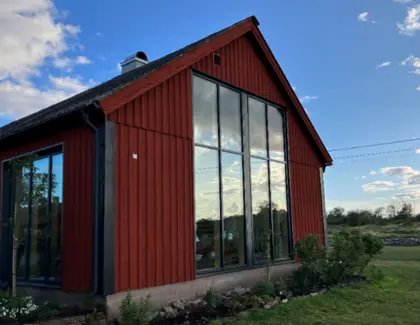
Daylight, less reflection . Photo Oskar Storm
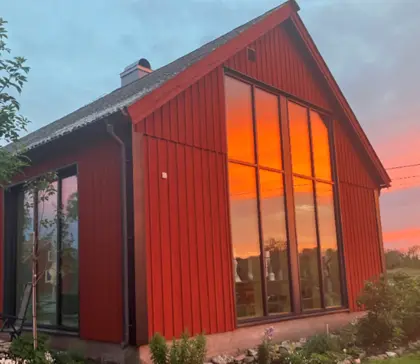
Twilight. The uncoated glass was deliberately used for reduced visibility to inside and better-looking reference images. The advantage of the coated glass is that it takes a step back and allows other facade materials to stand out better.
Low-reflective glass is very attractive under the right conditions. When light comes in from two directions, the glass becomes completely transparent. And at a very sharp angle, all glass looks reflective, because the glass surface is highly glossy. I want to demonstrate my thesis with references, from dark to light.
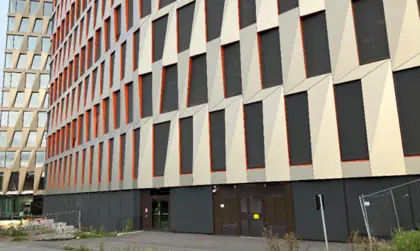
Valle View, Helsfyr Oslo, 12 degrees Celsius and partly cloudy. Photo Oskar Storm
Standard low-reflective energy glass on the left in the picture gives a beautiful reflection of the sky thanks to the high-gloss surface. However, when a dark zipscreen is rolled down in front of the glass, the impression is always dark regardless of the angle.
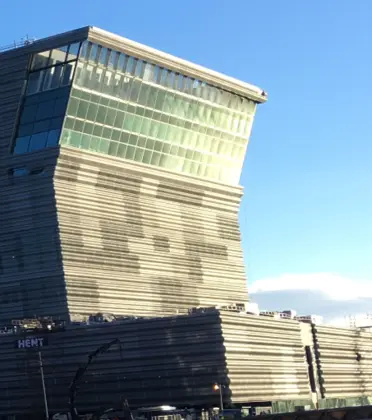
Munch Museum, Oslo. Foto Oskar Storm
The Munch Museum has fixed external solar shadings in aluminum on the vertical facade. Despite a 50% openness factor, they completely hide the glass. On the inclined facade, light only comes in from one direction, which gives a dark expression. Finally, the glass reflects the dark fjord and not the sky. Which completes the impression of a tin can with an empty bottle lying on top.
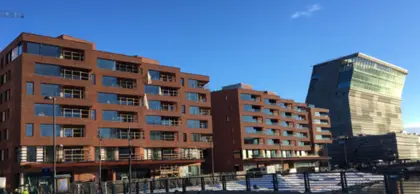
The low-reflective solar control glass at Munch Brygge makes us see a brick house with large windows. More reflective glass would have instead given expression to a facade of glass and brick.
Munch Brygge lies next door to the Museum and glazed with the COOL-LITE® XTREME 70/33 solar control glass. The glass is supplemented with external screens that are used surprisingly little (I check every time I walk past, a minimal empirical investigation). Probably because solar control glass reduces the operative temperature, the feeling that the sun is very hot through a window. The large windows lie next to balconies. The balconies have glazed doors that stand perpendicular to the facade. The result is a high daylight factor inside that emphasizes the transparency of the glass. And when you look at the glass from an angle, the blue sky is reflected in it.
There is a minimal difference between Munch Brygge and the Munch Museum when it comes to light transmission and reflection. In fact, the solar protection glass on the adjacent opera house has lower light transmission and higher reflection. Where the Munch Museum angles downwards, the opera house angles upwards. Where the Munch Museum has a low daylight factor, light instead enters the opera house from three directions.
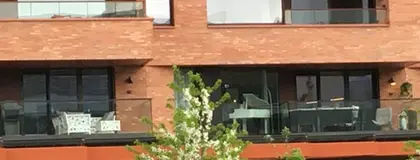
A white grand piano at Munch Brygge. Is it indoors or outdoors? Photo Oskar Storm
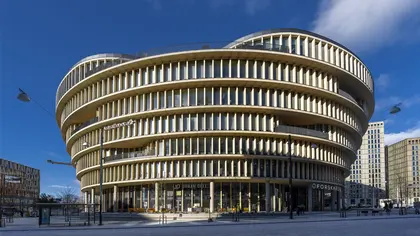
Kv Forskaren In Stockholm shows how little difference there can be between different glasses if you choose low-reflective glasses. On the top floor it is glazed with COOL-LITE® XTREME 61/29 and the floor below it is glazed with COOL-LITE® XTREME 70/33. All glasses are low-iron DIAMANT®. As long as the background is dark you can't see how clear the glasses are. Photo Sören Håkanlind
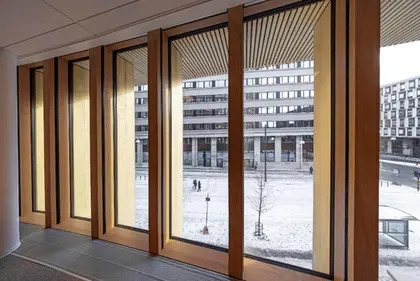
Excellent view through triple-glazed COOL-LITE® XTREME 70/33. Photo Sören Håkanlind
When light falls in from multiple directions, the glass appears brighter. Here is an example from Wisdome in Stockholm.
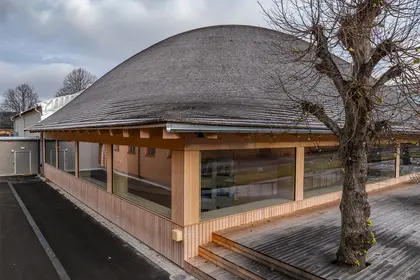
Solar control glass COOL-LITE® SKN 183 on DIAMANT®. The low-iron glass does not reduce reflection, but the coating is non-reflective. The further into the room you look, the darker the glass appears
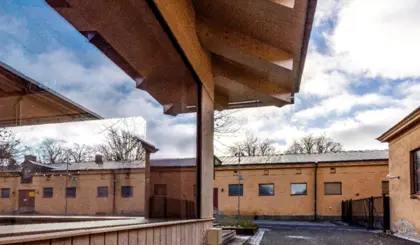
What is reflection and what is transmission at the corner of Wisdome? The photo clearly shows that the solar control glass steals some of the visible red light in its quest to eliminate infrared heat from the sun. The house in the background looks more blueish through the glass than in plain sight.
The most striking example of the effect of the right lighting conditions is the atrium at Gate:01 Frösundavik, the former SAS headquarters in Stockholm. The original atrium facade was glazed with uncoated double glazing. There was a conservation requirement that the expression of this facade could not be changed. But with new activities planned under the glass roof, there were demands for improved thermal comfort both summer and winter. The solution was double glazing COOL-LITE® XTREME 70/33 DIAMANT®. It is very similar to the solution at Kv Forskaren.
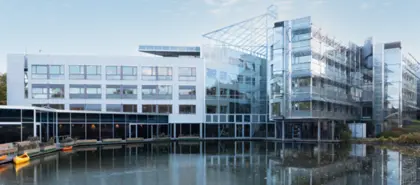
Gate:01 Frösundavik. Foto: Lars Olsson
The new atrium at SAS's old headquarters is so bright that it changes many people's perception of what a solar control glass looks like. This is thanks to light neutral glass, low reflection and light coming in from three directions. The building's glazing also becomes an exposition of the history of solar control glass: The restaurant on the right in the picture focused strongly on the glass providing some glare control. Since the water surface outside could cause unpleasant glare at lunchtime. Old style 8 mm body tinted Parsol Grey create dark sunglasses. Light and energy transmission are both close to 30% in the restaurant's glass. The atrium reaches up to 70% light transmission with equivalent solar control. Which nicely sums up 40 years of rapid development of solar control glass.
The external impression of internal solar shadings
When you install internal solar control roller blinds, they actually brighten up the facade. They also create complete privacy, at least in daylight. It may sound very similar to external zip screens, but that is not the case: The high-gloss glass surface is in front of the solar control. At an angle, the solar control is therefore invisible. Seen perpendicularly, it looks like a light grey roller blind. A woven sun protection blind can have a very high reflectance but does not cause glare because the structure with threads diffuses the reflection completely.
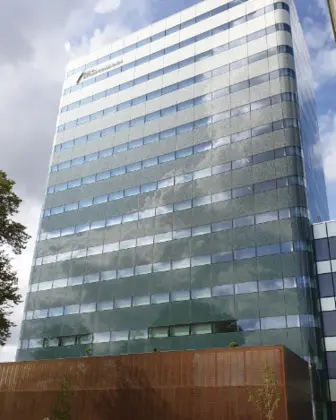
Interior roller blinds for solar control activated at Regionens Hus in Gothenburg. The last three windows on the right of the facade have no roller blinds as there is a fire escape staircase behind the glass. The bent corner glass is COOL-LITE® XTREME 70/33 just like the flat glass. The convex curvature reflects a larger part of the surroundings, which gives a glossy illusion of higher reflection.
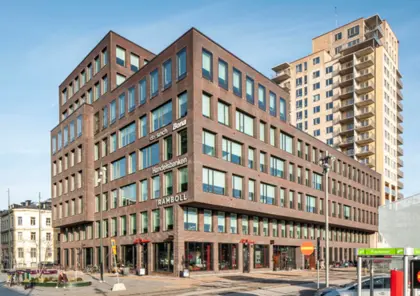
Shadings activated at the Foajen in Malmö. It is common to try to let in daylight under the roller blind where it cannot cause glare. The glass looks a little more greenish when the curtain is down. Normally the reflection is determined by the outer glass, which was described in detail at the beginning of the article. But the lighter surface behind the glass means that the view-point moves in to see through all the glass. Like any light curtain, really. When you look through three glasses, the green tone of the glass comes out stronger. A good alternative is to take reference photos of a building on a cloudy day when the solar control is not activated. Photo Felix Gerlach
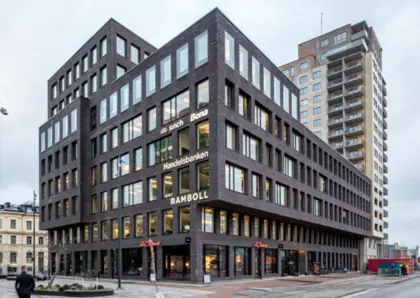
Foajen on a cloudy day. A brick house with large windows. Photo Felix Gerlach
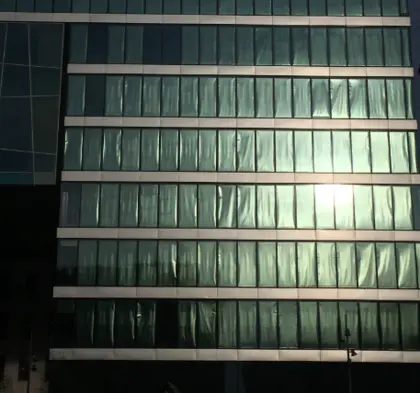
Activated glare/solar control highlights the transparency of the glass. At Kv Forskaren, the iron-free glass counteracts a green tint. Some creases may occur in the sun protection. There is no standard that says how pronounced this effect can be. The top floor stands out as darker. No difference in reflection but COOL-LITE® XTREME 61/29 has lower light transmission than COOL-LITE® XTREME 70/33. Difference in glazing due to difference in fixed shading. Also the wood at the top floor is more exposed to wheather than on floors below. Photo Sören Håkanlind
There are exceptions that confirm the rule. If the interior shading is made of film instead of textile, glare can occur. This is because the film is completely flat and lacks the diffusing effect of the textile.
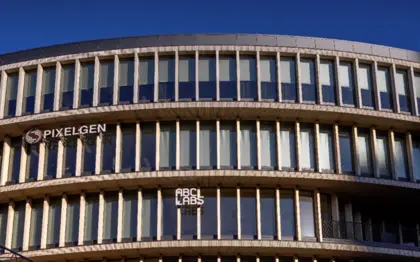
The PWC building in Oslo has been equipped with film-based roller blinds. They are very effective but not aesthetically pleasing. Photo: Oskar Storm
The impression of glass from the inside to outside
We are used to judging the expression of a building from the outside. But the user's perspective is looking out from the inside, and in many ways that is the most important perspective. The user can gain great benefits from the right choice of modern glass. As previously mentioned, solar control glass lowers the operational temperature, that is, the perceived feeling of heat against the body in direct sunlight. The feeling of light without heat is almost scary the first time you experience it (for me it was at Regionens Hus in Gothenburg 2020). The view to outside has also improved with each new generation of solar control glass.
Explaining the difference in the view through low e glass and solar control glass is tricky, but I intend to try. First, I want to create a reference level with the clearest possible low e glass. This is conveniently done in the entrance to Liljewachs+ in Stockholm. A public place with the most beautiful ECLAZ® LUMI in the format 2.5x6 meters:
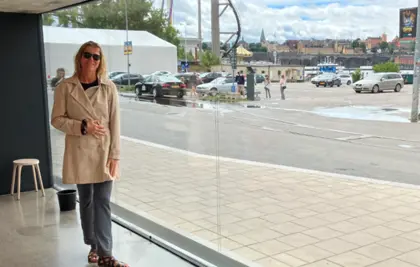
The glass is barely visible, but note the guiding ropes for the external sun screens. The zip screens are regulated by the staff and they say they can handle a lot of heat before giving up the view.
Then we have the lightest solar control glass COOL-LITE® SKN 183 for which references are starting to appear. Wisdome at the Technical Museum in Stockholm is a great place to see it.
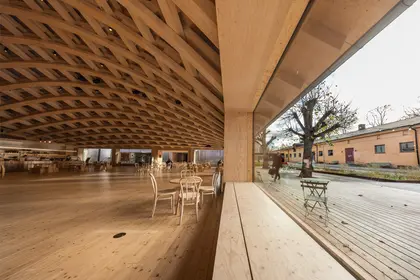
Is there even a glass there? Photo: Sören Håkanlind
Then you have to look up a reference where you see both solar control glass COOL-LITE® XTREME 70/33 and low-e ECLAZ® LUMI in the same room. At home in Tryggehuset we have it like this:
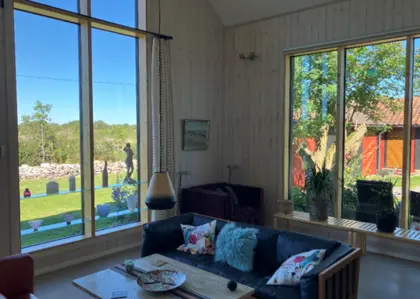
Triple glazing ECLAZ® LUMI on the left and triple glazing COOL-LITE® XTREME 70/33 on the right
The solar control glass on the right in the picture (east) only lets through half as much solar energy as the one on the left (north). On the right, the light transmission is ten percentage points lower than on the left. For the uninitiated, no real difference is perceived.
Another good comparison is to open a door in the middle of a glass partition:
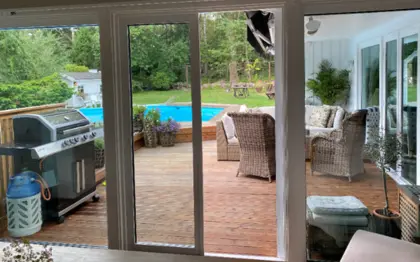
Villa Anders in Gothenburg, double glazing COOL-LITE® XTREME 70/33. Photo: Anders Hall
View through internal solar shading
At home in Tryggehuset, we immediately purchased interior roller blinds with solar control function in the large window section facing east. I knew that the solar control glass would need the help of an internal solar shading to achieve thermal comfort in the house. We did not consider the view towards the courtyard to be particularly valuable. We chose the room-side color of the solar shading to match the beige panel. Later, we discovered that excessive temperatures indoors were also caused by background radiation coming in through the north partition. That is where we have the most beautiful view, so we chose the darkest possible color on the room-side of the inside shading. Both fabrics are metallized on the outside for maximum glare reduction and effective solar control. Both are ClearView from Kvadrat Shade, 97% of the view is obscured by the curtain.
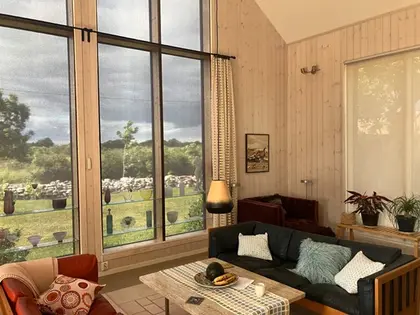
In the summer, both curtains are closed in the full ceiling high room in the morning. After 11 a.m. we raise the one on the east side. In the north, we have problems with background radiation all day, with direct sunlight early in the morning and during the evening.
Black inside gives a superior view compared to beige. The picture is a bit unfair because the black fabric is in shadow. But there are also shaded areas on the light curtain.
The conclusion of the article is that solar control glass has refined its spectra in transmission over the years. This allows less solar energy in and better color rendering in the view to outside. Light solar control glass is usually the given starting point when tackling a solar-exposed facade. The appearance of the facade is difficult to assess. It depends a lot on the lighting conditions outdoors and the daylight factor indoors. The color in reflection is very dependent on what is reflected.
I would like to end with a picture of a mock-up for an upcoming building in Stockholm. It consists of ECLAZ® LUMI in shop windows, COOL-LITE® SKN 183 in apartments and COOL-LITE® XTREME 70/33 in offices. You can see that all the glass provides an excellent view, but after reading the article you realize that you have no idea how the glass will look in the finished building.
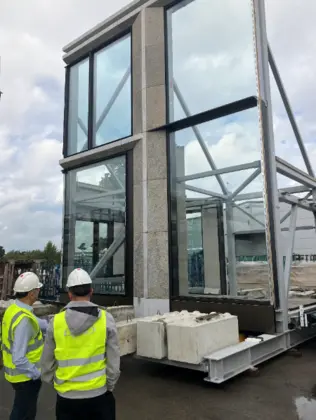
Mock up outside UPB's factory in Liepaja, LV. Photo: Oskar Storm.