
Transformation of Tryggehuset

– effort for old house renovation – part I
In 1980, my mother-in-law Annalena Holst converted an old barn into a residential building. It is beautifully located in Tryggestad on the alvar outside Borgholm and had very nice - but postage stamp-sized - windows.
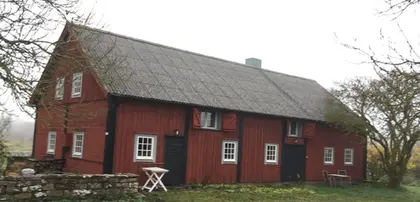
Tryggehuset november 2018
In 2021-2022 we renovated and rebuilt the house. The beautiful location in the corner of the village with an undisturbed view of the alvar in two directions made us take on the project. Together with the fact that we saw the opportunity to open up the floor plan internally using large window sections to let in daylight and create contact between outside and inside. The construction was a painful process that could have become an episode of Reality TV, but that is material for another article. Here I want to focus on the views to outside. What choices have we made to fit the window openings into the interior? And how have we done to avoid excessive temperatures and long reverberation times, two companions to the Nordic light and the stripped-down Scandinavian interior style?
Preserved original windows
Kitchen window 2018
The original windows are beautifully barred and sit relatively high, their old-fashioned look makes them perfect in a barn conversion. But thick insulation meant that they were set deep and let in minimal light. On TV we saw a renovationtaht had a solution for the color of the window: In an old croft window, the inside was black and the outside was yellow-ochre. Black is a color that doesn’t catch the eye. With a black inside, the eye can get past the bars and reach outside the walls of the house. However, the window sills must be white. White reflects daylight and is the reason why all the walls and ceilings are painted white. White is the color used in daylight analyses. All other colors are fads to me.
The bathroom was the most successful. White tiles with gray-black grout completely sync with the window bars. Thanks to the high location of the window, it could sit above the sink. And there, you’re used to looking forward. The whitewashed window sill works well for toiletries and the necessary mirror.
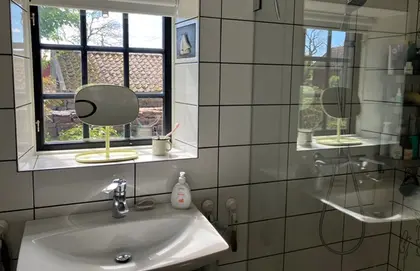
A slightly wider sink from Ifö matches the width of the window. With the correct slope to the floor, we opted out of the overflow protection for a cleaner design. The shower wall is 8 mm tempered glass of the Timeless type. The limescale-repellent surface and the total of three point fixings make it easy to keep clean and new. When you have an en suite bathroom with a glass door, you need to install a PVC blackout curtain in the bathroom.
The old windows and their height above the floor also fit well in the kitchen. We avoided the usual problem of the window sill being lower than the kitchen counter. In the kitchen area downstairs, the cool shades dominate.
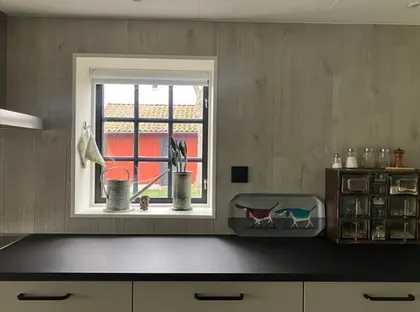
Kitchen from IKEA with black fittings and matte black worktop and black electrical outlets. The sun protection curtain Indre 1001 from Markisol is suitable for the kitchen environment, it is made entirely of PVC and can be folded and washed with chemicals. With an openness factor of 3%, it gives a pleasant view to outsiude with a touch of linen curtain. The tray is from Åry Form and the old-fashioned storage for dry goods we found in the carpenter's shed.
Transformation of doors and gateways
The west side of the barn is part of the village skyline, we didn't want to change it. The limestone wall has very small windows, how dark would it be in the bedroom?
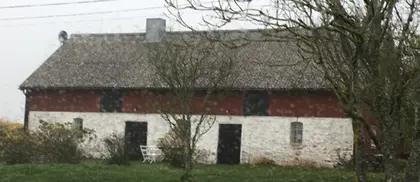
West side, rainy November 2018
The gates to the west were something that really surprised me positively. On the inside, they were insulated in 1980 with small doors without any real light entry. When we demolished the old inner wall, an arched opening appeared that widened inwards, perhaps to make it easier to herd the cattle? A Leca block wall was built inside the limestone wall. It stands 3 cm from the old wall and the air gap is insulated with Leca balls. There is a fairly large window section in the lime-plastered Leca wall. This maximizes the light and shows off the old brickwork in a good way.
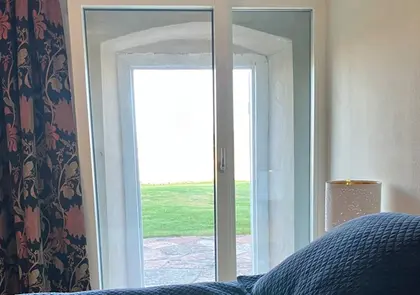
The Leiab window consists of a fixed part and an openable part, tilt/turn. COOL-LITE® XTREME 70/33 solar control glass lets in “light without heat”. On hot days we close the door as additional sun protection. The door is now painted white, the black one attracted too much heat.
The door to the ”Breakfast room”
Our architect Leo Eriksson said that not all old doors need to become new doors. A doorway is a good place for a window opening. The kitchen bench ends at a door that has been transformed into a fixed window. This provides a solid light source. On the sofa from Zero/Lustrum you can keep company with the person who is cooking and look out over the courtyard.
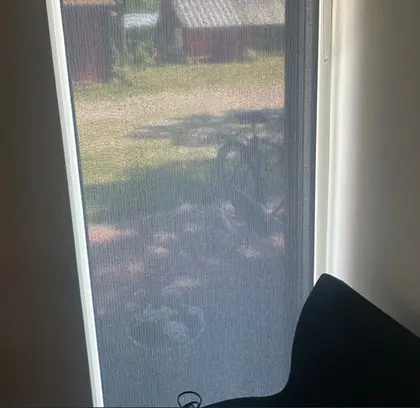
Fixed Leiab windows facing east consist of COOL-LITE® XTREME 70/33 solar control glass. To avoid excessive temperatures, the glass is supplemented with internal solar shading Apo X from Kvadrat Shade. This particular roller blind is a novelty in 2025 as the anthracite grey inside has a geometric pattern in beige. The view is somewhat obstructed by the pattern, but the materiality of the textile reaches completely new heights. The transparency factor is 2% and the fabric actually has acoustic properties.
Front door
The old double door was very low and completely custom-made, a format that could not be changed. But we are very happy with the replacement, the highly insulated glass door from Purso. It stops all drafts, which is important in the middle of our open plan kitchen-diner-living room. Both door leaves have door closers that can keep out the Island storms or provide a standing opening when large items need to be brought in. The light and view are superb.
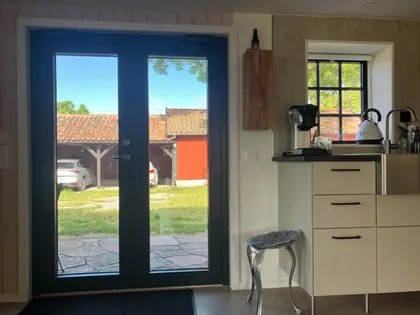
RAL 7016 gloss 30 is used throughout for aluminum doors and all exterior sheet metal work. Discreet and suitable for Falu red and yellow ochre. Glass COOL-LITE® XTREME 70/33. From the "coffee corner" you can see in all directions. The key cabinet was designed by Annalena. It was built by Elis Nilsson, who also crafted the windows.
New openings
Annalena built the north end of the barn on what was a ruin. The construction method was modern without the old beams. This has allowed us to lift out the intermediate floor. The 209 cm ceiling height becomes five meters in the last third towards the north. This is where the major intervention has taken place. The largest possible rectangle has been sawn out of the gable and a glulam beam carries 16 square meters of glass surface in the middle. Nine square meters have also been sawn out of the east wall. This creates a tranquile room with great height and depth.
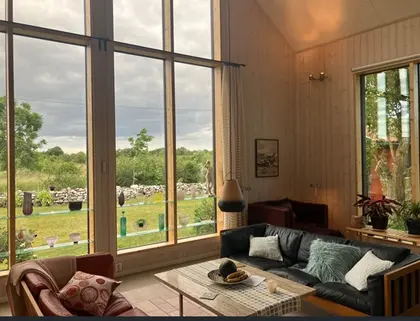
The bARK® facade system is based on glulam all the way to the window glass. It gives a pleasant wooden feel and warmth, no cold drafts in winter. Glulam makes it easy to screw glass shelves in the recesses. To the north, the lightest possible glass ECLAZ® LUMI and to the east, COOL-LITE® XTREME 70/33. ECLAZ® LUMI is a laser-treated low e glass. Standard low e glass gives a slight yellow tint to the view that is not found with ECLAZ® LUMI.
To the east, inherited flower benches from Alvar Alto adorn their place. All lighting is directed upwards or downwards to avoid glare, the birch lamp above the table from Örsjö Belysning hangs on a very long cord.
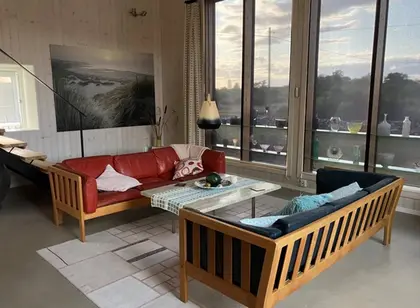
This room is made for Annalena's old fine room interior from the 60s with a travertine marble coffee table and leather sofas from IKEA.
This room should actually be plagued by heat and noise. But the COOL-LITE® XTREME 70/33 solar control glass on the east is reinforced with an internal solar control curtain. The large window on the north turned out to let in an unexpectedly large amount of heat. That problem was solved with an internal solar control curtain there too.
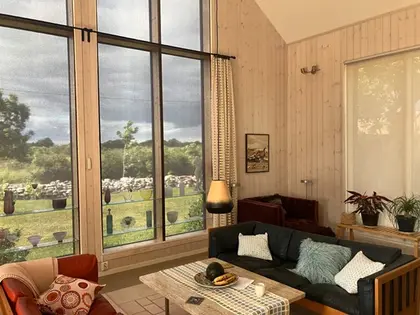
The curtains are motorized with silent Somfy Sonesse motors. The 275 cm wide roller blind in the east has a beige inside to match the white painted panel. The five-meter-long roller blind in the north has a black inside to maximize the view, which is required when only three percent of the textile is actually open. Both shadings are PVC-free ClearView from Kvadrat Shade.
Such a high room with such sparse furnishings and hard surfaces would have a church-like acoustics. But the ceiling has sound-absorbing panels. Ecophon Type F could be screwed directly into the old ceiling. This makes the sofas a good place for conversation and music. In the kitchen, which has a lower ceiling, the panels are suspended to create a smooth ceiling under the old (quite ugly) beams. The result is fantastic acoustics. “It’s so quiet and peaceful here,” people usually say when they enter. Our carpenter didn’t understand what we were going to do with the fragile white squares of 600x600 mm. But when he went from the plaster ceiling in the bathroom with its unlimited reverberation time to the total silence in the bedroom, all his question marks were cleared up.
Under the roof sill
The roof of the house is made of eternit. Eternit roofs are beautiful and have a long lifespan. But there was never a question of installing skylights. It breaks the impression of a barn, and you shouldn't cut into the asbestos-containing eternit. Annalena raised the entire roof to give good height on the second floor. But over a wall length of 15+15 meters, it only allowed for four windows that are down to the floor and shaded by the eaves.
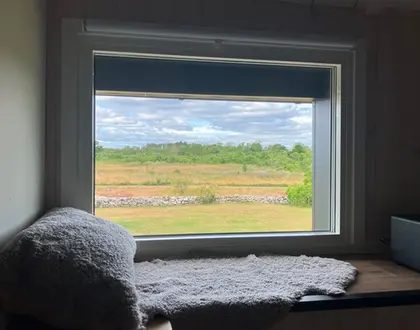
It's sad to have so few windows facing west, which has the nicest view. In this deep nook by the stairs sits a fixed Leiab window whose sun protection glass the reader can guess by now. The place is made for playing guitar or relaxing. But I almost never end up there, somehow programmed to sit in furniture.
The upstairs is generally simpler in terms of materials, with vinyl carpet, white plaster walls and an original, white-painted ceiling. It houses a TV sofa, gym and office for me and my beloved wife Åsa.
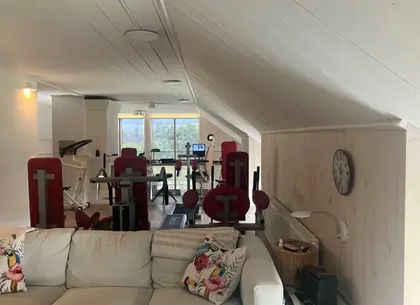
The workplace on the edge of the mezzanine was an image that kept me going when it was the hardest. That's where this article was written. I find it interesting that the interior photos get a more even light when the sunshade on the north is down.
This article intentionally avoids showing flashy pictures from the outside. Google “Tryggehuset” if you are curious. The purpose of the article is to show how much thought one should put into renovating an old house. During the period 2018-2021, we were here almost every weekend to support Annalena. It gave her and us the opportunity to think things through carefully. She designed houses herself and was the one who brought in Leo Eriksson. Leo’s main contribution was the large window to the east and his belief that an old barn should have as open a floor plan as possible. Hopefully, the article can serve as inspiration.