
Talking about sand for glass production

Geologist Jan Mikaelsson from Nybro knows to tell about the origin of primary materials for glass production:
"About 200 million years ago, the Iberian Peninsula collided with the rest of Europe. The impact was so powerful that the granite in the Småland bedrock cracked and in the cracks rose material from the interior of the earth. What does this have to do with glass? Well, some cracks were filled with pure silicate in so-called silicate passages. And later became the first raw material for glass in the Småland Glass Kingdom. The silicon graves have long since been emptied, and if you're incredibly unlucky, you can fall into the ditch after an excavated passage that runs like a trench in the Småland forests."
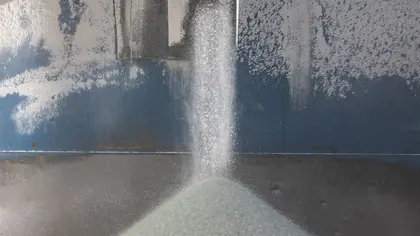
Here is a parallel to modern glassmaking: We melt sand that we take out of sand pits to make glass. 850 kg of sand is used to boil 1000 kg of glass. And these quarries will one day be empty. And then we need alternatives. Overall, a lot of sand is used in the world. Above all in civil engineering and especially the concrete for infrastructure and buildings. So, for example, enough concrete is produced each year to build a wall 27 meters thick and 27 meters high all the way around the equator. A completely different sand quality is used for concrete than that used for glass production. For concrete, it is the shape of the sand grains that is important, they must not be too round and runny. For the glass, it is the purity, to obtain a sand without impurities that discolor or produce insoluble particles in the glass mass. It is therefore not from the same sand pit that we extract sand for glass and concrete respectively. At the same time, the float method for glass manufacturing is cost-effective, which has led to a multiplication of flat glass production since 1970 and a sharp increase in sand extraction around the globe.
So what is so special about sand for glassmaking? And how much is left?
Jan Mikaelsson continues:
"Quartz sand is a weathering product of above all granite. When other parts of the granite have weathered away, the fine-grained quartz remains. And the whiter it is, the cleaner it is. And the longer it has weathered, the rounder it is, the phenomenon is called spherical weathering" Here, Jan makes visible the differences between sand for concrete and sand for glass. We want sand that contains minimal feldspar. Feldspar is a red iron compound that turns green in the glass. Other impurities can yellow the glass or give rise to stones in the glass. The white sand in Böda beach is an example of pure sand that has weathered from granite. White sand is also found in Polynesia, but there it is weathered coral. The concrete industry cannot use this sand because the sand grains are too round, it is called spherical weathering. It has weathered for too long and cannot take hold of the other ingredients.
But we have developed methods to use this type of round sand for glass. So, in theory, we should be able to empty white sandy beaches in Böda and Polynesia before we reach peak sand. Of course we shouldn't, but the example shows the difficulty of determining when the sand has run out and that certain assets must be left behind for all other reasons. The right sand is otherwise very rare in Sweden or Norway, Jan thinks that the grounds in Barkarp outside Habo possibly meet the requirements. Emmaboda Glas took its sand all the way from South America to reach ULIC (Ultra Low Iron Content) and Pilkington in Halmstad obtained LIC (Low Iron Content) sand from riverbeds in Belgium.
In the rest of Europe floatworks tend to be located close to their sand deposits. Because the sand is so cheap that transport is a critical cost.
As I said, there is no concrete answer to the question of how much sand is left. There is no official mapping of the sources of glass-grade sand. But we can say with certainty that it is a finite resource. And we cannot rely on being able to exploit all sources to the last grain of sand. Taking too much sand out of a river bank can change the course of the river. If you want to extend the sand quarry in a lake up onto the beach, you have to get a permit, which can be quite difficult (think Böda...). It is high time to start evaluating alternatives.
The seemingly obvious choice is to melt down old flat glass for new. In the glass industry, we always see ourselves as a sustainable alternative because it is possible to remelt glass an infinite number of times without losing mass or quality. Nevertheless, 95% of flat glass in Europe goes to landfill and windows are one of the largest remaining fractions for landfill at Sweden's 583 recycling centers.
How can it be so?
The answer must be that sand is cheap and natural gas has been relatively cheap. With a cost-effective process and cutthroat competition, glass has been one of the cheapest sheet materials in the construction industry, where the large formats were sold for a few paltry kroner per kilo. So recycling old flat glass has not been profitable. Especially as it is risky to recycle flat glass into new flat glass, a small contamination of, for example, aluminum from spacer profiles can ruin production for several days.
What is now influencing the glass industry to reduce the use of the primary material quartz sand is an increased focus on the CO2 footprint. And of course the sharply rising prices of natural gas. Recently, natural gas has quickly become the increasingly overshadowing cost in glass production. Almost the only way to lower that cost item is to mix in more existing glass, we call it cullet. You can boil 1200 kg of sand, soda and lime into 1000 kg of glass in a few days or quickly melt down old glass and thus reduce gas consumption by 30%. The cullet can come from the float plant's own production, but of course this does not provide a cost advantage. Internal cullet stabilizes the float process, but the aim is that as much as possible of what is melted can also be delivered. It is instead about getting hold of cutting waste from glass refiners (pre-consumer cullet) or recycling centers (post-consumer cullet). Together, we call these two recycled fractions external cullet.
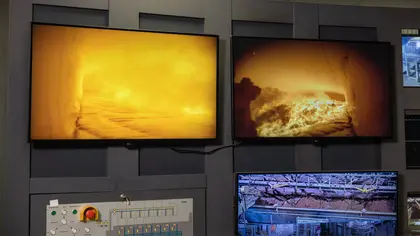
The drive towards CO2- neutral glass thus leads, by extension, to a drive away from primary materials. And can extend the glass age, which otherwise in its current form is threatened within 50 years due to lack of sand. François Guillemot is "Chef de Projet Glass Low Carbon" at the French Saint-Gobain group: "We can already today raise the percentage of cullet in float glass production to 70% without affecting aesthetics and strength. If you exclude internal cullet, this means that the percentage of recycled material in flat glass can be increased to over 50%. Thereby, the market potential for properly recycled flat glass is basically endless.”
Björn Glenn Hansen at Norwegian Glass & Fasadeforeningen is committed to the topic: "Sand is the most demanded raw material on earth after water. From a sustainability perspective, glass is too cheap, even with today's prices. Too cheap because the glass material still ends up in landfill. The glass industry must contribute with increased recycling and reuse. What cannot be recycled as new flat glass should go to the production of, for example, glass wool or glass foam. So that the amount of flat glass in landfill is minimized.”
In Sweden and Norway, Ragn-Sells invests in the recycling of flat glass. Camilla Sonnentheil is the business developer who managed the process: "I am very happy that Ragn-Sells can offer a fully adequate alternative for recycling flat glass. So that we in Sweden can help save a primary material that we cannot produce ourselves. This means that we can all help to preserve the sand between our toes.”
Photos ©Saint Gobain Sekurit
The article was prepared by
Oskar Storm
Mikael Ludvigsson