
Solar control window film is part of a larger tool box

Solar control window film, like solar control glass, has improved over the years. Both products have moved towards a better relationship between light transmission and heat transmission, i.e. increased selectivity. In addition, the reflection in the films has decreased and the color rendering in the view to outside has improved. There is also low-e film for improved u-value in windows.
Solar control window film is 0.05 - 0.2 mm thick. It gets its properties in a sputtering process in the same way as coated glass. A retrofitted solar protection film can improve an existing window instead of replacing the glass. This at a much lower cost than having new glass installed.
The glass industry has so far mainly seen solar control window film as a competitor and that the right choice of glass is always a better alternative to applying film. And that solar control window film changes the properties of the glass in a way that makes it impossible to stick to the condensation guarantee of the insulating glass. But we cannot deny the fact that a film has a negligible carbon footprint compared to glass. Therefore, we need to add solar control films to our toolbox in the construction industry.
The schism between glass and film runs deep and it has not been easy to discuss our way to a common text. We have defined a purpose for the article – to focus on thermal comfort. It is a concept that has precise definitions, but can simply be described as moderately warm indoors. There are a number of excellent applications for film such as decoration, glare control and protection/safety, but we will not touch on them here.
Too cold indoors
Retaining heat in the room is the biggest challenge for a window. Heating still consumes far more energy than air cooling in Sweden. Development in the last 20 years has been at a breakneck pace in this area. When renovating a building, windows and doors are a priority measure. You get a clear reduction in heating costs and increased comfort as cold drafts occur much less frequently.
When renovating windows with connected frames, it is energy-efficient to replace the inner pane with a hard-coat low e glass, which reflects back 85% of the long-wave energy that wants to leave the room. The glass is a little greyish and steals seven percentage points of daylight, but offers an excellent compromise between cost and effect. In a 2+1 construction (connected frame with single glass/blind/double glazed unti) and uncoated glass, you get a radical improvement if you replace the old insulating glass with one with soft coat low e glass: The coating inside the insulating glass reflects back at least 97% of the energy that wants to leave the room, without stealing any daylight.
There is low e film for interior application, but it absorbs a lot of daylight and cannot be installed in a position where it becomes competitive.
Too hot indoors
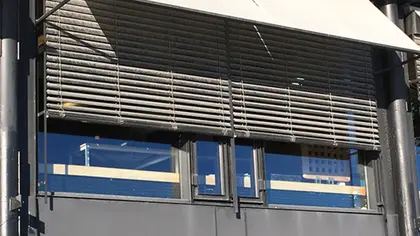
Oslo, February 11 2019, desperately seeking solutions
As I said, solar control window film has made great progress in the last fifteen years. The most important thing is that the product can now be applied to the outside of the glass, face one as we say in the glass idiom. It does not have much significance for connected windows, the inside of the outer glass has always been an excellent choice for solar control film, but it revolutionizes the use on insulating glass. And here there are partly new and important areas of use.
There is a mistake that is more common than others in energy renovation and that is that an old linked window is replaced with a modern triple-glazed window. The anti-glare blind is moved from sitting between the single panes to sitting inside the triple-glazed unit. Here you miss the fact that an intermediate blind provides powerful solar protection, a closed white blind can prevent 80% of the solar energy from entering the room, an internal blind in the worst case does more harm than good in stopping the solar energy. We get excellent comfort in winter but two to three times more solar energy into the room on summer mornings. With excess temperatures as a result. There should have been a light solar protection glass in the window if it faces east, south or west to balance the new position of the blinds. The most common response is to buy a mobile air conditioning unit.

Overheating response, Nordhavn CPH, March 18 2025
A better measure than blinds is to install an internal solar shading roller blind. But if you don't have solar control glass, there is a risk of thermal breakage on the middle or inner pane.
Instead, we recommend installing a light solar control window film on the outside of the insulating glass. In many cases, the film nearly fully corresponds to the performance you get from window suppliers' solar control options for both daylight and solar heat gain. And solar control window film has a negligible carbon footprint compared to a new insulating glass unit - climate smart!
The solar control window film is positioned on face one and a normal solar control coating is on face two of the insulating glass unit. This means that the outer glass heats up more when using solar control glass than when using solar control film. The insulating glass heats up less and the pumping effect is slightly reduced. The risk of condensation inside the insulating glass is therefore no greater if you put a solar control film over the entire outer pane than if you choose solar control glass. The Flat Glass Association in Sweden has therefore extended the condensation guarantee for insulating glass to include external solar control film.
To block out even more heat, the solar control film can be combined with internal solar control, the film has basically eliminated the risk of cracking on the inner glass. We have different opinions here, Niklas is happy to install a more powerful film, but Oskar wants to maintain a light transmission of over 60%. If you already have solar control glass and need better protection, internal solar shading is a clearly better alternative than solar control film. A new feature in the ESBO calculation freeware, that feeds data to IDA-ICE, is that you can choose solar control window film. Not combined with a solar control glass but fully applicable for 90% of cases.
Conclusion
The glass industry must adapt to the fact that glass alone cannot solve problems with thermal comfort. The window/facade is part of a complex system that also includes solar shading, ventilation and cooling systems. Building regulations have been tightened so much that the system must be analyzed at the product level to meet the requirements at a reasonable cost. In addition to allowing external solar film, it must also be accepted that internal solar shading should be hung as close to the glass as possible for the best efficiency. A solar control glass or a solar control film also minimizes the risk of thermal breakage of intermediate and inner panes. Quite simply because they reduce the heating of these glasses.
Solar control film should be removed from windows before they are discarded. Thus making the window easier to recycle.
The article was prepared by
Oskar Storm
Niklas Falck
Find out more about our products