
Renovation windows and facades

This article deals with ordinary window glass, not the type of reflective solar protection glass that was most common before the turn of the millennium but is still present. This means that a window or facade always looks dark from straight ahead. Because glass has a fairly low reflection at that angle and inside the room it is usually at least 50 times darker than outside on the street.
But when you look at glass from an angle, the reflection increases drastically and then differences arise between different generations of glass. It is this type of angle that is important from a conservation point of view. Therefore, the outer glass is the key to the appearance of a facade. In 2021 I was in contact with Ellen Ronsten, who is a building antiquarian at Kalmar Läns Museum. She wrote this:
"We usually encourage this type of energy efficiency of older windows, so if it is only the glass in the inner frames that is replaced, I see no problem with the renovation from an antiquarian point of view."
I wanted to change the glass pane in the inner frame to hard-coat low e glass.
How does the outer pane differ? Well, only from the mid-1970s were all windows manufactured with float glass that is perfectly plane-parallel. Earlier glass came from various types of mouth-blown techniques or continuous production of drawn sheet glass. The surface is not optically perfect, and this causes deviations in the glass surface when viewed at an angle.
If there are conservation requirements, old single windows should remain intact as much as possible. Instead, an extra window can be built inside that increases energy performance. In this case, it is appropriate to use low reflection in the glass and dark colors on the outside of the frame. So that these can be hidden by the relative darkness in the room. This was done during the renovation of the Old National Archives in Stockholm. Below are examples from different variants at the Solsiden shopping center in Trondheim.

Turquoise windows inside single glass windows at Solsiden Shopping, Trondheim.
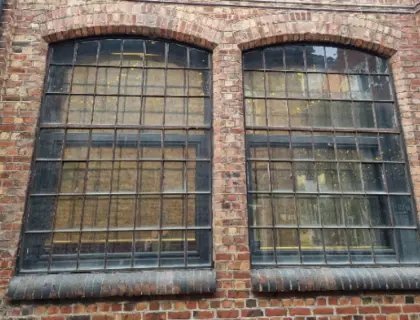
Black framed window inside single glass on same building. Dark grey frame with mat finsih is the ideal for discreet second window.
Coupled sashes 1+1 are very common in Sweden, usually with drawn shett glass, which usually gives a vertical waviness in the glass. Here you can work quite freely with the inner pane. The simplest solution is to replace the inner glass with a hard-coated energy glass. The weight is largely unchanged. But the u-value improves from around 2.7 to 1.8 and you largely avoid inside condensation. That's what I did myself in a 1950s house. With the bonus that cracked panes in the outer sash could be replaced with original glass from the inner sash.
Hard-coated glass is quite reflective and not beautiful. Therefore, the view can almost be improved if you can mill space for an insulating glass in the inner sash. These IGUs are difficult to make thinner than 16 mm, increase the weight by up to 10 kg per m2 and need to be covered by the frame at least 12 mm so that the spacer profile is not visible. This method achieves significant performance improvements and can even provide for solar control glass. The table below summarizes the possibilities.
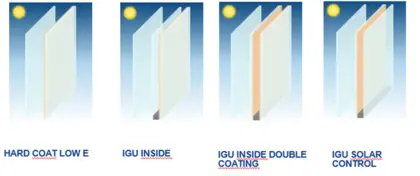
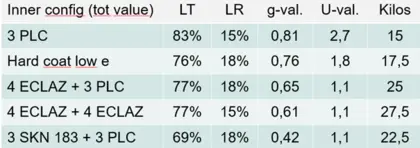
New windows in old buildings
When it comes to new windows in old buildings, I have been in contact with Ellen Ronsten again. We have slightly different views on how to approach the problem.
Ellen Ronsten: “As an antiquarian, I generally recommend that when replacing windows in an older building (such as the 1960s and older) you try to have window glass with “life” in it, that is, drawn sheet glass or cylinder blown, depending on the age of the building of course. Then you achieve a type of reflection adapted to the building. We never specify coatings, mostly because it is a modern phenomenon. Then there are certainly situations where such glass can be a good solution, but perhaps primarily in newer buildings.
We also usually focus a lot on the choice of material in the frame and sash, as well as the hanging of the sash, when replacing windows in an older building is a question. For example, if it is an older house that had mullioned wooden windows, the recommendation is usually that the new windows should be wooden windows without aluminum elements, with side-hung sashes and fixed wooden mullions with a putty rebate."
Oskar Storm: The degree of preservation of windows in Sweden is impressively high. I went for a walk in old parts of Oslo and found almost nothing but float glass. I have stayed several times at Nikolauskloster outside Düsseldorf in Germany. The old brick building has, like so many in those surroundings, been renovated with PVC windows.
So I have to draw a line when it comes to windows with good wood frame: During the Swedish 1960s expansive housing program, the quality of wood in windows declined and solutions other than side-hung were introduced. Pivot-hung windows in particular suffer from major problems with tightness that preclude renovation. And the volumes needed preclude new production with drawn sheet glass. Climate change also places new demands on U-value and solar control in our windows.
When you want to install new windows and facade parts, you can use modern coatings that removes reflection in the surface they are on. Then the glass takes a step back and the focus lands on other building parts such as bricks. But should the outer glass be coated?
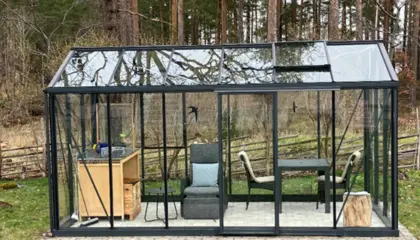
Our greenhouse illustrates how uncoated glass appears perpendicular and at an angle.
When you have an environment with old windows, I think you should have a coated glass (#2) as the outer glass. Then the new glass takes up as little “space” as possible. If you are going to replace old float glass with new in this type of preservation, it may be better to use uncoated outer glass. The picture below of glass samples illustrates the difference. The sample in the middle has uncoated outer glass. Measured perpendicularly, all three glasses have exactly the same reflection, but at an angle there is a difference. With a coating of #2, you can use modern solar control glasses that in a triple-glass design reach up to 70% light transmission.
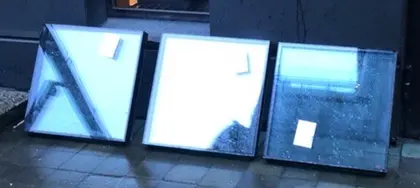
Glass samples left and right have coating #2 and #5, centre sample has coating #3 och #5
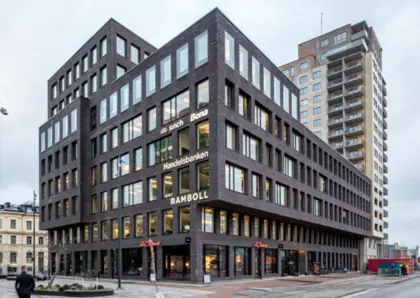
Foajen in Malmö has triple glazing with reflective coating #2 and #5. On the ground floor, the shop fronts have been designed to target the reflection of single glazing. The glass takes a step back, it becomes a brick house with large windows, not a glass and brick facade. On the 6th floor, uncoated single glazing is placed at the very edge of the facade for various reasons. They are very prominent.
Renovation curtain wall facades
Some conservation objects have particularly exotic coatings from the last millennium. The golden glass of the Kaknäs Tower is an example of this. As is the TV tower in Berlin. Such objects must be treated on a case-by-case basis. But many early facades were built on ordinary float glass, such as the Hötorg skyscrapers. When these are renovated, the aim is to improve energy performance and often add solar control glass.
It is a blessing in itself that modern solar control glass in many cases does not differ significantly from ordinary low e glass in appearance. For Saint-Gobain coatings, an untrained eye cannot see the difference between the low e ECLAZ® LUMI and the solar control glasses COOL-LITE® SKN 183, COOL-LITE® XTREME 70/33, COOL-LITE® XTREME 61/29 or even the new COOL-LITE® XTREME 51/23. So what is there to hesitate about? Of course, there is the fact that uncoated float glass is much more reflective from an angle than coated glass. The facade becomes a little darker. The difference may be difficult to see but should be evaluated.
You can crack the nut with a triple-glass solution with a coating on the middle glass #3 and the inner glass #5. Then you have basically solved the aesthetics with the uncoated outer glass. For low e glass, there is no disadvantage if you toughen the middle glass. But with solar control glass, you must first evaluate whether it is approved for #3 at all, it can look really strange. From Saint-Gobain, only COOL-LITE® SKN 183 is approved for #3. Then you need to think about whether you can handle the reduced efficiency. Solar control glass absorbs heat that is ventilated away by the wind, in the middle of an insulating glass it is windless. You can do analyses in Building Simulation Programs such as IDA-ICE.
A successful example of facade renovation is the huge atrium at SAS's old headquarters in Frösundavik, now called Gate:01. Both the system and the uncoated double glazing were to be replaced, but the appearance was to be preserved over 3,500 m2. It was Wicona for aluminum and COOL-LITE® XTREME 70/33 DIAMANT® in double glazing. The double glazing had to have the solar protection glass on the outside. But that was no problem in a room with light coming in from three directions. Here it has always been difficult to catch any reflection in the glass. The comfort inside has changed, the old glazed street is now a lounge environment. And the only thing you notice is actually a faint greenish glow on the walls closest to the glass.
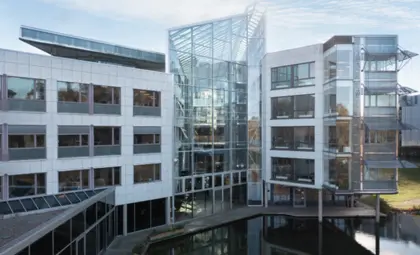
The atrium's solar control glass is difficult to see. The uncoated windows on the right and left sides deviate, but mainly due to the much lower daylight factor.
At Gate:01, both glass and aluminum were recycled. Nothing new for aluminum, but for glass it was the starting point for recycling. Windows are the largest fraction in landfills in Sweden. But from now on, Ragn-Sells can recycle windows into new glass raw material. I would say that in principle all glass that is currently replaced can be recycled. On the Glascentrum website there is a list of trained inventory personnel who can help you take the first step in your project!