
Evolution of shopfronts from 1693 to nowadays

The shopfront used to be
The display window is important to attract customers into a store, at least for spontaneous visits. It has always been essential to be able to present your goods in an attractive way.
Further back in history, the problem was that mouth-blown and drawn glass had poor optics and distorted the impression of the goods. Which actually led to shop windows being instead manufactured according to the same principles as mirrors: By casting glass substrates where the surfaces were then polished by hand over several months until a perfect plane-parallel surface was achieved.
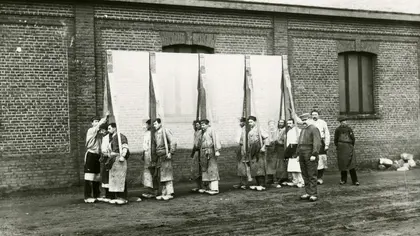
© DR Archives de Saint-Gobain
In 1693, a large factory for the manufacture of cast flat glass was built in the village of Saint-Gobain outside Paris. Manufacturing had begun here as early as 1665 to produce material for the Hall of Mirrors at Versailles. But now what we would today call a giga-factory started. With this factory, world production of cast and polished glass was doubled. Every day hundreds of carriages arrived and departed by horse and cart; timber for the ovens in and wooden boxes with glass packed in straw out. A nearby canal port led to Paris and the rest of the world.
Transport of display windows, Saint-Gobain factory in 1858. The glass almost reaches the ground, but the reflection of the sky only begins at waist height.
The production method was increasingly industrialized. But the principle of casting a substrate which was then polished would remain the same for mirrors, shop windows and vehicle glass for the next 250 years. Ornamental glass is still manufactured in that way today, but without polishing.
The conclusion is that shop windows were for a long time a very exclusive material that cost quite a lot of money. But that it was considered worth the investment. It was only when the float glass method had its breakthrough in the 1960s that shop windows became somewhat uncomplicated. There were no rules for personal protection back then so many Swedish shop windows still today consist of 6 mm single glass.
Houses in inner-city locations were thus built right up to the present day with single glazing in large windows on the ground floor for shops and smaller openable windows with connected frames for 1+1 glazing higher up. The lower the reflection the darker a glass surface appears. These houses thus get a dark base that ties them to the ground and lighter reflection higher up.
Shop fronts now:
In recent years, there have been demands for energy saving, personal safety and burglary protection.
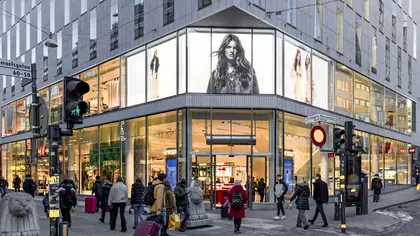
©Sören Håkanlind
As I said, shop windows have always been single-glazed - with a u-value of 5.6. A glass surface reflects 4% perpendicularly and even more from an angle. A single glass has two glass surfaces, which gives 8% reflection. Double glazing gives 15% reflection and triple glazing 20% reflection. Since 1988, there has been iron-free glass that is clearer than ordinary float glass, but the reflection is the same. The more glass surfaces, the worse the shop window.
You can try to distinguish a newer double-glazed shop window from an old single-glazed one by seeing how well you perceive the interior. This exercise can be done along any shopping street in the Nordics. Requirements for insulating glass are thus an obstacle in market communication. But we can solve the problem by putting more resources into shop windows again.
Anti-reflective glass is probably the first thing that comes to mind. Then you can get even lower than the reflection in single glass, the glass can become completely invisible like the protective glass in front of the Mona-Lisa. But it is terribly expensive, it can cost over SEK 1,000 per m2 to extinguish reflection in one glass surface. And it's risky to do it on the outside. Cleaning, decals etc. cause scratches which, together with dust, becomes extra prominent. Because they seem to float in the air when the surface is non-reflective.
My recommendation is to use standard coatings instead: Low e glass and solar control glass have long been developed in the direction of low reflection in order to maximize daylight. However, you need to be careful here, because different coatings distort colors to different degrees. Solar control glass blocks some visible red light and low e glass can appear yellowish.
Saint-Gobain's low e glass ECLAZ® LUMI, which is laser treated, represented a breakthrough: The reflection is lower than non-reflective glass and it has no yellow tint, so it fights on equal optical terms with non-reflective glass. At a fraction of the price.
References can be found above all in Malmö on projects such as Foajen, Aqua and Priorn. There, triple glazing has a combination of ECLAZ® LUMI and non-reflective glass to reach single glass reflection of 8%. In all these cases there were requirements for solar control glass on certain facades. The outer glass is therefore the low reflecting solar control glass COOL-LITE® XTREME 70/33. It only lets the wavelengths of daylight through, but maximizes these.
The Foajen project is a brick house that, despite its advanced glazing, manages to look traditional with a dark baseline of single-glazed look and similar 1+1 mirroring effect in the window glazing on the floors upwards. However, with single glass reflecting triple glass, it often becomes quite complicated with long delivery times and high prices.
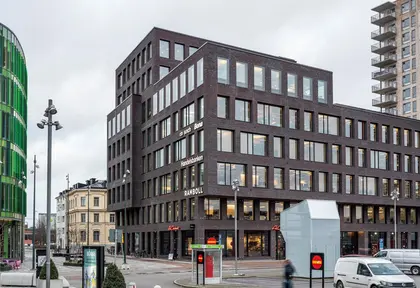
Foajen Malmö, vi äger bilden eller likvärdig i hög upplösning. Fotograf F Gerlach
The shortcut is to do what you can: If you can get an energy calculation where the shop windows can cope with double glazing, the extra cost will be close to zero: Use ECLAZ®+ECLAZ® or the right quality solar control glass together with ECLAZ® LUMI. If it has to be triple-glazed, you can at least get down to 11% reflection with ECLAZ®+ECLAZ®+ECLAZ®. At Magasin X in Uppsala, COOL-LITE® XTREME 70/33+ECLAZ®+ECLAZ® was applied in the shop windows, at Liljan & Tulpanen in Norrköping COOL-LITE® SKN 183+ECLAZ®+ECLAZ®.
By the way, the lighting conditions are important to sharpen or blur the last reflection in the glass. Shop windows can have a white background and strong lighting to enhance visibility. But it is difficult to fight against daylight, which is often 100 times stronger than artificial light. Then it is good if you can instead cooperate with daylight: If another window can let in daylight from the side, from behind or from above, the light in the display is constantly adapted to the light outside.
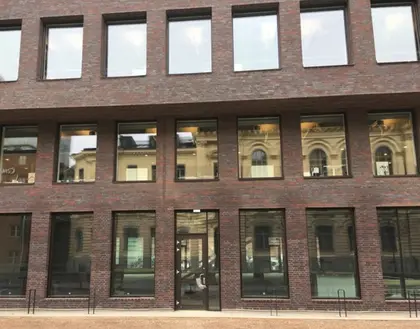
The Foajen. At ground level 8% reflection, levels 2 & 3 14% reflection. Note how the reflection is weakest where light falls in from behind. Photo Oskar Storm
What about safety glass and burglary protection? Laminated glass is often used. It may feel heavy and expensive but think about the upside: PVB laminated glass blocks the UV light that causes fading in fabrics. Which gives a chance for the shoe in the display to keep the same color as the shoe in the box. And two glasses that are laminated together do not have a higher reflection than a single glass. Tempered outer glass and laminated inner glass are preferred to avoid thermal breakage. The reverse if the area is subject to vandalism.
This entire article focuses on looking from the outside to inside. But the lessons can also be applied from the inside out. Every building with an exciting view, from sky bar to shelter, gets a better view with low reflection. After dark, low reflection and the right lighting are necessary if you want to see more than yourself in the window.
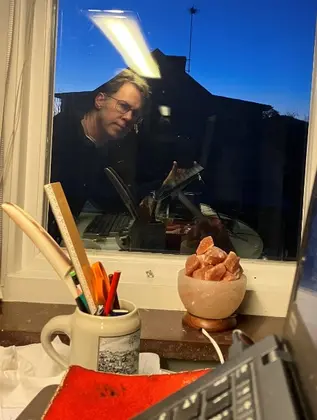
The author seeking view to outside at dusk